

Google Ads

La Refonte insights
Learn how to build an effective digital marketing strategy for your SME, from the seven core pillars to KPIs, with quantified examples and an actionable seven-step method.
Google Ads

SEO

Refonte
A digital marketing strategy is a structured plan that defines how your business will use digital channels, including SEO, social media, paid advertising and email, to achieve specific, measurable commercial objectives. According to HubSpot (2024), businesses with a documented strategy are 313% more likely to achieve their objectives than those operating without clear direction.
In France, 78% of B2B buying journeys begin with a Google search (source: Google, 2024). Your prospects are actively looking for your services. The question is not whether you should be online, but how to establish an effective presence. A well-designed digital strategy organises your activity around four key stages: attracting qualified visitors, converting them into leads, retaining existing customers and analysing each initiative so that you can continually improve it. This is the RACE Framework, adopted by thousands of European SMEs.
The difference between an SME that generates leads predictably and one that remains exposed to market fluctuations often comes down to a single factor: whether it has a documented digital strategy. This article gives you a complete method for building yours, from the initial audit to performance indicators, with practical examples and SEO strategies tailored to SMEs.
313%
more likely to achieve objectives with a documented strategy (HubSpot, 2024)
61%
lower cost per lead from SEO than outbound marketing (Search Engine Journal, 2024)
3,200%
median email marketing ROI: €32 generated for every €1 spent (DMA, 2023)
78%
of B2B buying journeys begin with a Google search (Google, 2024)
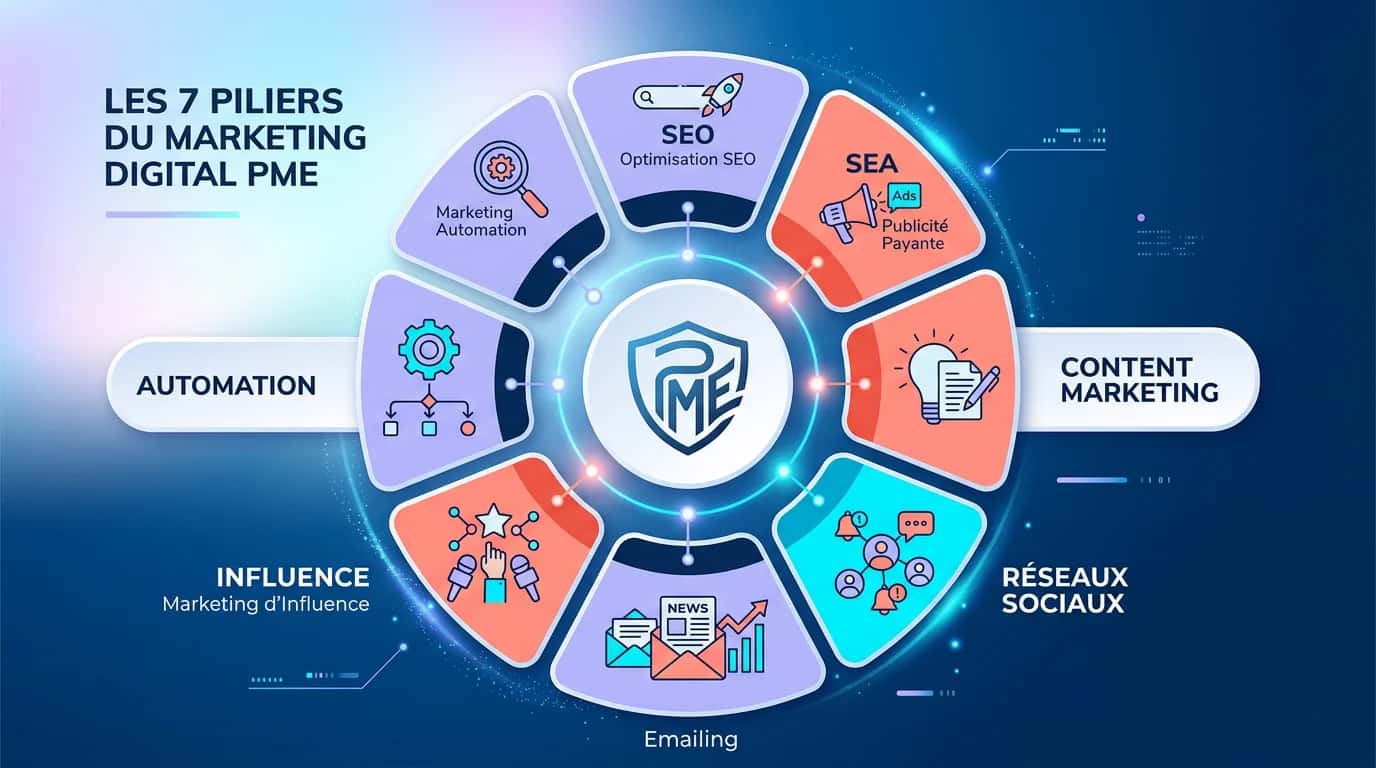
Digital marketing encompasses all the techniques used to promote a business through digital channels. Unlike traditional marketing, every initiative can be measured in real time, a decisive advantage for SMEs with limited budgets. These seven pillars form the complete framework for a high-performing digital presence and underpin any robust digital marketing strategy.
SEO (search engine optimisation) means improving your website so that it appears on the first page of Google for the searches your prospects make. It is the channel with the best long-term ROI: once your pages rank well, they generate traffic around the clock at no additional media cost. A structured SEO marketing strategy combines a technical audit, content creation and backlink acquisition. On average, SEO leads cost 61% less than outbound leads (source: Search Engine Journal, 2024).
Paid search, through platforms such as Google Ads and Bing Ads, can deliver immediate results for competitive keywords. Unlike SEO, the traffic stops when you stop paying, but well-structured campaigns can generate measurable ROI from the first month. According to WordStream (2024), the average conversion rate for B2B Google Ads campaigns is 3.75%. It is an ideal way to test messages quickly and accelerate growth.
Creating blog articles, videos, infographics and white papers supports your SEO and establishes your business as an authority in its field. According to DemandMetric (2023), content marketing generates three times as many leads as traditional advertising at 62% lower cost. It also powers your conversion funnel: a prospect who reads three blog articles is three times more likely to convert than a first-time visitor with no previous interaction.
The right platform may be LinkedIn, Instagram, Facebook or TikTok, depending on your audience and industry. Social media supports both awareness through organic posts and direct acquisition through social advertising. For B2B SMEs, LinkedIn remains the most profitable network, with a cost per lead 28% lower than Google Ads in service industries (source: HubSpot, 2023). In B2C, Meta Ads can deliver ROAS above 4× for ecommerce campaigns using interest-based audiences. For a practical continuation, see How Does Google Ads Really Work for an SME in 2026?.
Email is the marketing channel with the highest ROI: a median 3,200%, or €32 generated for every euro spent (source: DMA, 2023). It is also the only channel you control completely, as your email list is not subject to a platform's algorithms. Segmentation, personalisation and automated sequences can turn a database of 1,000 qualified contacts into a predictable revenue engine.
Working with niche content creators, particularly micro-influencers with 10,000 to 100,000 followers, lets you reach highly targeted audiences with an engagement rate three times higher than that of macro-influencers. For SMEs, local or industry-specific micro-influencers offer the best value, with fees ranging from €200 to €2,000 per post depending on the industry and platform.
Automation, including triggered email sequences, advertising retargeting and chatbots, lets you nurture leads without adding staff. Businesses using marketing automation generate 80% more qualified leads and convert them 77% more often (source: Marketo, 2023). For an SME, even a simple post-visit email workflow can halve the abandonment rate for contact forms.
Étape 1
Before taking action, map your current position: website traffic in Google Analytics, SEO rankings in Google Search Console, social media presence and the performance of active campaigns. Identify your three main traffic sources and each one's conversion rate. This audit will invariably reveal two or three quick wins, meaning high-impact actions that require little effort. A structured website audit will give you a sound basis for prioritising investment and avoiding a repeat of existing mistakes.
Étape 2
Without quantified objectives, you cannot measure success or decide where to focus. Each objective should be Specific, Measurable, Achievable, Relevant and Time-bound. Practical examples include ‘Generate 30 qualified quote requests per month through the website within six months’ or ‘Reach 500 organic visitors per day within 12 months’. Avoid vague aims such as ‘improve our online visibility’: they provide no basis for decision-making and motivate no one.
Étape 3
A persona is a semi-fictional representation of your ideal customer, covering their age, role, company, daily challenges, preferred information channels and objections to buying. Interview five to ten of your best existing customers to identify common patterns. This step is critical: a generic message aimed at ‘everyone’ converts no one. Businesses using documented personas generate 124% more leads than those without them (source: Cintell, 2023).
Étape 4
With limited resources, you cannot do everything, and trying to do so is the first mistake. Prioritise no more than two or three channels based on your industry, audience and in-house capabilities. A useful rule of thumb is to begin with SEO as a long-term investment, combined with one rapid acquisition channel such as Google Ads or Meta Ads. Use the comparison table below to choose according to your primary objective: immediate acquisition or sustainable traffic.
Étape 5
Content is the fuel for your digital strategy. Develop a monthly editorial calendar with two to four SEO-focused blog articles, two or three LinkedIn posts each week and one monthly newsletter. Consistency matters more than volume. One strong article every fortnight will outperform ten mediocre articles published in a rush. Every piece of content should answer a precise question asked by a prospect at a particular stage of their buying journey.
Étape 6
Attracting traffic is pointless if you fail to convert it. Optimise your funnel with a home page that communicates a clear value proposition within five seconds, dedicated landing pages for each service, short forms with no more than three fields and conversion tracking configured in Google Analytics. The B2B benchmark for website-to-lead conversion is 2–5%. Below 1%, your funnel is broken and your advertising budget is being wasted.
Étape 7
Each month, review your core KPIs, including traffic, leads, cost per lead and conversion rate by channel. Identify the two actions that delivered the strongest results and invest more heavily in them. Stop initiatives that show no results after three months. This discipline of continuous optimisation separates SMEs that progress from those that stagnate. Reserve 20% of your budget for testing new hypotheses, as the best opportunities often emerge through experimentation.
| 01Channel | 02Type | 03Time to results | 04Minimum monthly budget | 05Long-term ROI | 06Best for |
|---|---|---|---|---|---|
| 01SEO | Organic | 3–6 months | €500–€1,500 (specialist fees) | Very high | Sustainable, qualified traffic |
| 02Google Ads (paid search) | Paid | 1–7 days | €500–€2,000 (media spend) | High when optimised | Fast, measurable acquisition |
| 03Meta Ads | Paid | 1–7 days | €300–€1,500 (media spend) | High in B2C | Awareness and retargeting |
| 04Content marketing | Organic | 3–12 months | €300–€1,000 (content creation) | Very high | Industry authority |
| 05Email marketing | Opt-in | Immediate | €50–€200 (software) | Very high (32×) | Retention and lead nurturing |
| 06Organic LinkedIn | Organic | 1–3 months | €0 (time only) | Medium | B2B personal branding |
SEO
Google Ads (paid search)
Meta Ads
Content marketing
Email marketing
Organic LinkedIn
Defining your performance indicators before launching your strategy is just as important as the strategy itself. According to Gartner (2023), 68% of marketing budgets are invested in underperforming channels because KPIs are not monitored rigorously. Without data, you are flying blind and every decision rests on instinct rather than evidence.
For SEO, track impressions and clicks in Google Search Console, organic traffic in Google Analytics, average rankings for your ten priority keywords and your organic conversion rate. Aim for organic traffic growth of 10–20% per quarter. For a practical continuation, see Google Ads Landing Page.
For paid search and Google Ads, track CPC (cost per click), CTR (click-through rate), CPA (cost per acquisition) and ROAS (return on advertising spend). A CPA above your unit margin indicates a loss-making campaign that should be addressed as a priority.
For email marketing, track open rate (industry benchmark: 21–25%), click-through rate (2–5%), unsubscribe rate (below 0.5% per send) and the list's conversion rate. In B2B, an email list of 1,000 qualified contacts creates more value than an Instagram page with 10,000 untargeted followers.
For social media, monitor organic reach, engagement rate (interactions divided by reach) and the number of leads generated through native LinkedIn forms or Facebook Ads. Engagement rate is the health metric; leads generated is the performance metric. To take this further, read Website bounce rate.
Monitor no more than five metrics linked to your priority objectives each week. Conduct a fuller review of trends each month. Avoid analysis paralysis: too many metrics hinder action. Configure automatic alerts in Google Analytics so that you are notified whenever a metric rises above or falls below a critical threshold. Your goal is to reduce your cost per qualified lead over time, as this is the ultimate measure of your digital strategy's overall effectiveness.
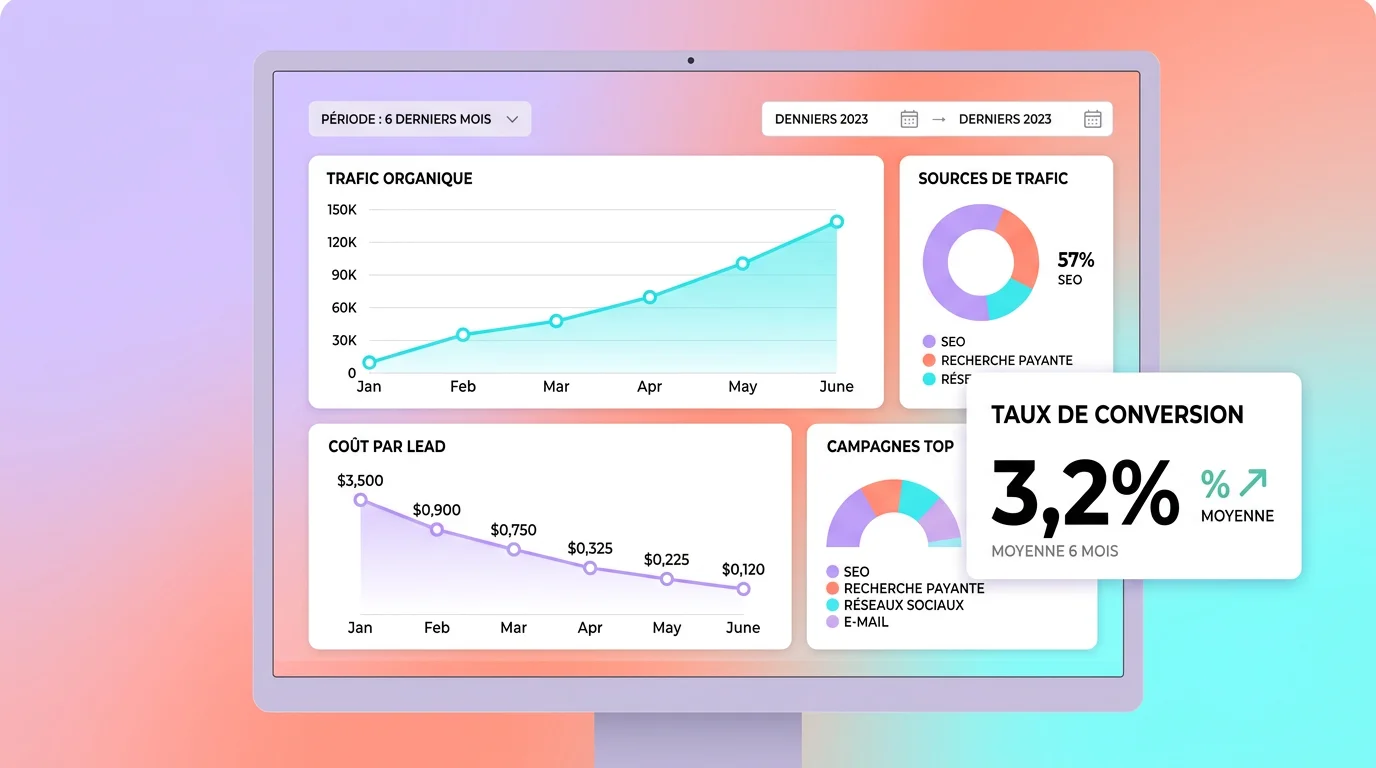
This consultancy served mid-sized businesses with HR advisory services. Before adopting a documented strategy, its marketing budget consisted of €3,000 per month in poorly structured Google Ads campaigns, generating four to six leads per month at a cost of €550 per lead. Its website attracted 280 monthly visitors, with no organic traffic and a 74% bounce rate. To take this further, read Website Design.
The eight-month strategy included a technical SEO audit, improving its Core Web Vitals score from 42 to 91 out of 100; 14 blog articles targeting high-intent keywords such as ‘HR consultant Bordeaux’ and ‘SME management consultancy’; a restructure of its Google Ads campaigns into six dedicated ad groups; and conversion tracking on the contact form. After eight months, the business attracted 1,240 organic visitors per month, up 343%, and 18 qualified leads per month, up 300%, while cost per lead fell to €180, a 67% reduction. The strategy delivered a 4.2× ROI over 12 months.
This sustainable fashion ecommerce business generated €60,000 in monthly revenue, with a Google Ads ROAS of 1.8× and no SEO strategy. Its problem was that 92% of traffic came from paid campaigns, leaving the business entirely dependent on advertising budgets and exposed to every increase in CPC. For a practical continuation, see AI Assistants.
The 12-month strategy involved launching an SEO-focused lifestyle blog with 24 articles targeting keywords such as ‘sustainable fashion’, ‘sustainable clothing’ and ‘slow fashion’; optimising product pages and metadata; and introducing post-purchase and abandoned-basket email sequences. Organic traffic rose from 8% to 41% of total traffic, overall ROAS reached 3.7× and monthly revenue increased by 68% without any increase in advertising spend. Email marketing now generates 23% of monthly revenue from a list of 4,200 active subscribers.
Digital marketing is not about technology. It is about understanding your audience and applying discipline in execution. The businesses that succeed online are those that publish consistently, measure honestly and never stop optimising.
While SEO and content marketing build your digital presence over the long term, Google Ads is the accelerator that delivers immediate results as your organic visibility develops. Combining SEO and Google Ads is the most robust approach for an SME: SEO secures long-term organic traffic, while Google Ads supports short-term acquisition and lets you test messages before investing heavily in content. To take this further, read Law Firm SEO in 2026.
A well-structured Google Ads campaign for an SME includes ad groups segmented by informational and transactional intent, a minimum Quality Score of 7/10 to reduce CPC by up to 40%, complete ad assets for calls, locations, sitelinks and prices, and conversion tracking for every form and phone call. According to WordStream (2024), SMEs that optimise these four elements reduce their CPA by 32% on average. Our page on SEO Studio explains the next step.
For SMEs launching or pursuing growth, Google Ads should form part of a broader Google Ads strategy. Begin by targeting high-intent transactional searches, where prospects are ready to buy, then expand gradually into Display and retargeting. The recommended minimum budget is €500 per month for a local B2B niche and €1,500 per month in a more competitive industry. Our Google Ads agency supports you from the initial audit through to continuous campaign optimisation.
Our team manages Google Ads campaigns for French SMEs and mid-sized businesses. Receive a free audit of your current campaigns and tailored recommendations within 48 hours.
Last updated: April 2026
Keep exploring

A project in mind?
Start with a free audit grounded in your goals, website and data.
Discutons de votre projet
30 min · Google Meet
Choisissez le créneau qui vous convient dans notre calendrier. On analyse votre situation avant l’appel pour aller droit au but.
Finding available times...