

Refonte

La Refonte insights
Customer acquisition cost measures what you spend to turn a prospect into a customer. Learn the formula, sector benchmarks, LTV:CAC ratio and practical ways to improve it.
Refonte

Google Ads

SEO
To reduce CAC quickly, start by improving website conversion so the traffic you already acquire produces more customers. Then build internal SEO capability if the team can publish, measure and iterate. Delegate when time or expertise is missing. The table below compares internal capability, tools and external delivery.
These three options solve different constraints. Keep internal time in the calculation: an action completed by your team is not free simply because no agency invoice exists.
| 01Build internal capability | 02Use a tool | 03Delegate |
|---|---|---|
| 01Read the data, produce SEO/GEO content and retain decision ownership | Audit, decision history and action prioritisation | Audit, strategy, production and reporting |
| 02Count the team's time in CAC | A tool does not deliver the actions for you | Define which costs and outcomes are included in CAC |
| 03Read our SEO and GEO cases | Use Google Search Console | Explore the SEO audit service |
Read the data, produce SEO/GEO content and retain decision ownership
Count the team's time in CAC
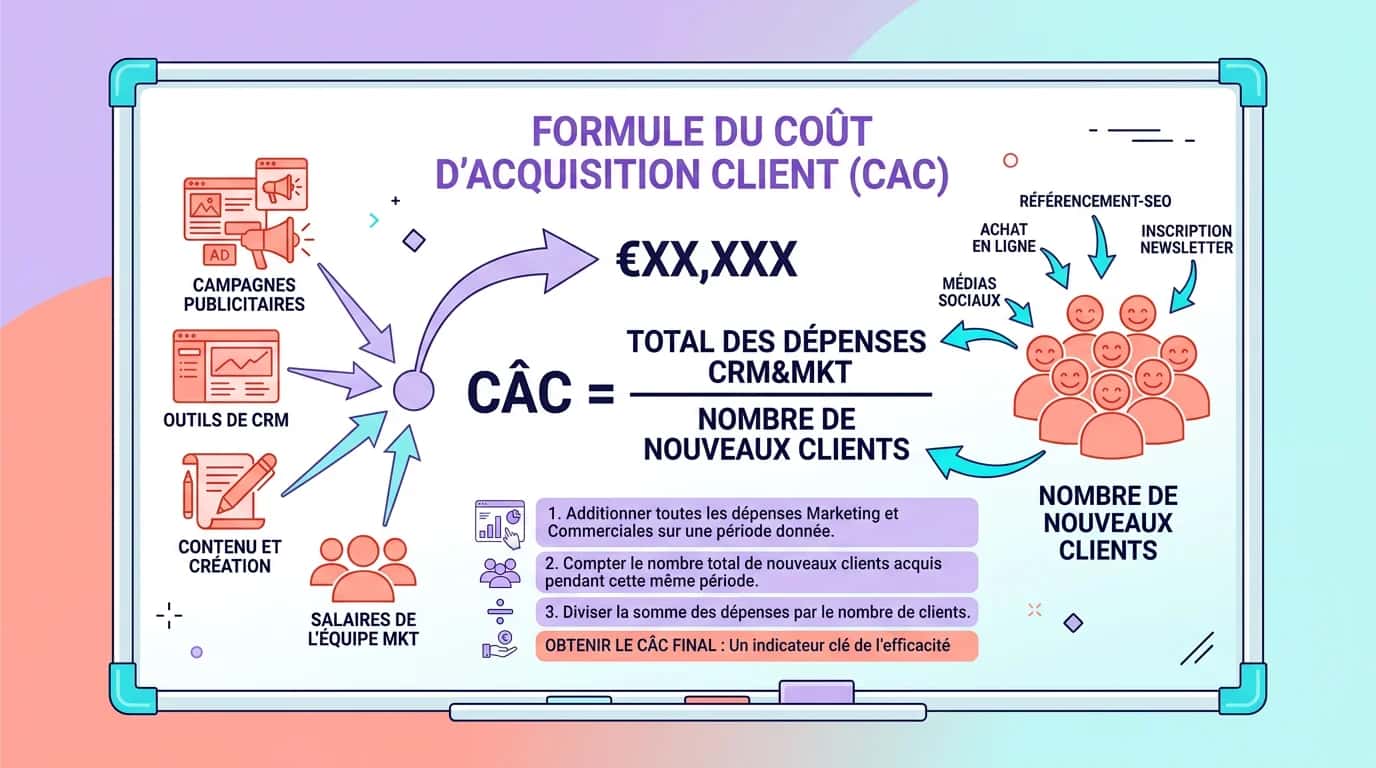
Customer acquisition cost (CAC) is total marketing and sales investment used to turn prospects into paying customers, divided by the number acquired during a given period. It directly measures the profitability of commercial activity.
CAC complements lead and traffic volume by answering the outcome-focused question: what does each new customer actually cost across every channel? A figure previously attributed to HubSpot could not be traced to a verifiable primary study and is no longer used.
CAC includes advertising through Google Ads, Facebook Ads and LinkedIn; marketing and sales salaries; CRM, automation and analytics tools; and content production, including Google Ads landing pages. Omitting any category makes the result artificially low.
New customers form the denominator of classic CAC. Count only their first paid conversion and attribute it to the channel you actually track. For a campaign-led sale, include media spend, sales time, tools and the production required.
Repeat customers should not be counted as new on every purchase. Their value belongs in LTV instead. Track referral customers separately: a recommendation may reduce paid media, but commissions, programme costs and management time still count.
Also separate lost customers who are reactivated. Email, sales calls or a dedicated offer create a reactivation cost, not a second initial CAC. This segmentation keeps acquisition, retention and win-back activity distinct and makes advertising, content, referrals, direct outreach and CRM follow-up comparable. For a practical continuation, see UX Design.
$41.83
E-commerce benchmark published by Shopify in April 2026
3:1
Common SaaS LTV:CAC reference point, to be adapted to the model
4 steps
To calculate a complete CAC and then segment it
1 period
Shared by the spending and new customers counted
The basic formula is CAC = (marketing spend + sales spend) ÷ new customers acquired. Use a defined month, quarter or year so results remain comparable over time.
For an illustrative example rather than a benchmark, an SME records €8,000 in advertising, €2,000 in content and €5,000 in acquisition-related sales salaries. It gains 30 paying customers during the same period, giving a fully loaded CAC of €500.
The figure means little alone. Compare it with margin and value per customer, and use a consistent convention when comparing periods and channels.
Étape 1
Choose a month, quarter or half-year that covers a complete sales cycle. An SME with a three-month sales cycle should not measure CAC over 30 days.
Étape 2
Include digital ads, marketing and sales salaries in proportion to acquisition time, CRM and analytics subscriptions, automation, and content such as articles, videos and landing pages.
Étape 3
Count customers who actually converted during the period, not leads. For subscriptions use the first paid subscription; for e-commerce, the first order.
Étape 4
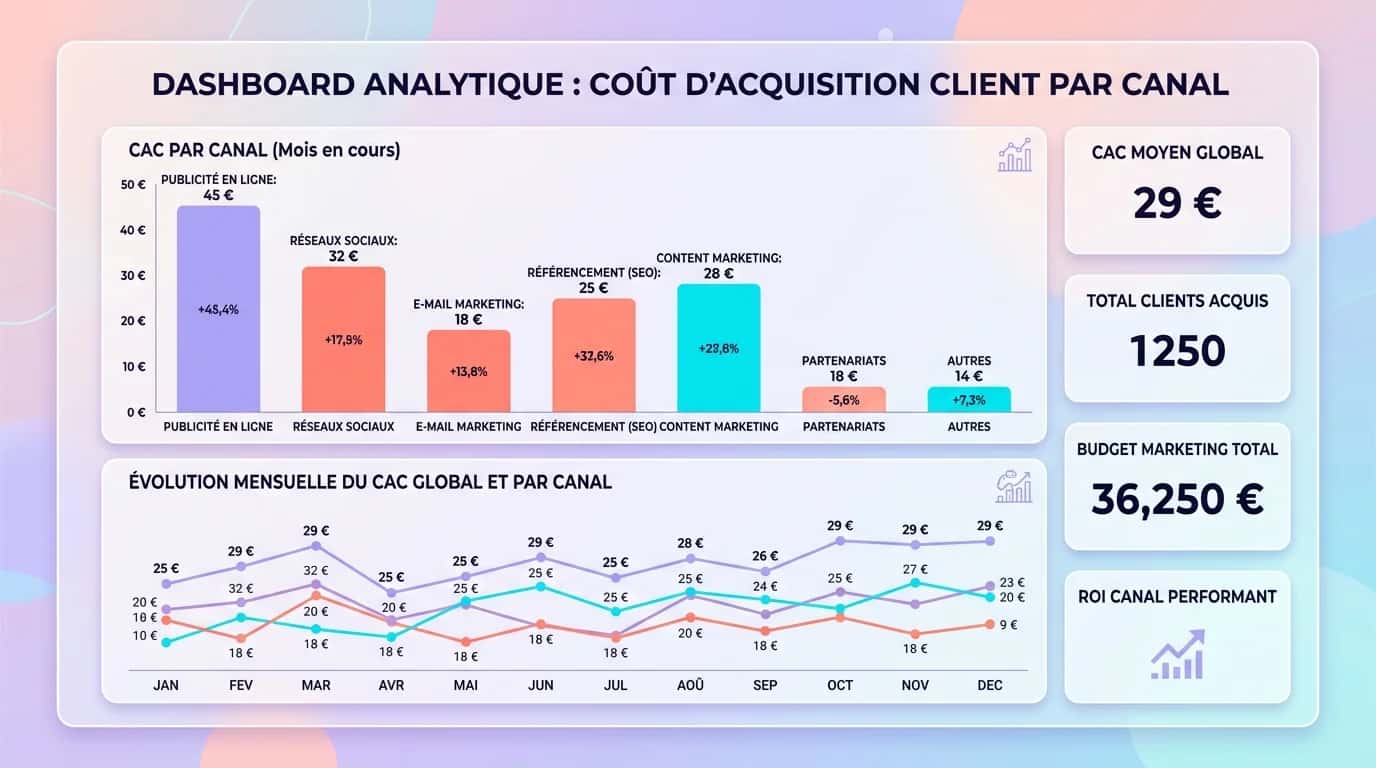
Divide total spend by customers for overall CAC, then calculate it for SEO, Google Ads and email to identify the most profitable sources.
A reliable CAC includes every direct and indirect acquisition cost. Counting only ad spend is the most common error.
Include Google Ads, Meta Ads, LinkedIn Ads, display and retargeting. Track channels separately: one euro in paid search does not behave like one euro in organic acquisition. For initial website investment, see website redesign price ranges.
Prospecting, qualification and sales time belong in CAC. Allocate fully loaded salaries in proportion to acquisition work.
Include CRM, email automation, analytics, advertising platforms and research tools, spreading annual subscriptions over the analysed period. Our page on Google Analytics for Your Website explains the next step.
Articles, videos, white papers and landing pages incur writing, design and integration costs. Because they vary too much for a single average, use invoices or actual internal time.
A sector average is comparable only when it covers the same market, period and costs. Previously cited ranges attributed to Statista, ProfitWell, HubSpot and WordStream could not be found in the stated sources and were removed rather than republished.
The e-commerce row below uses Shopify’s 2026 benchmark. No sufficiently traceable figure was found for professional development. For a practical continuation, see SEO in 2026.
| 01Sector | 02Published benchmark | 03Scope | 04Caution |
|---|---|---|---|
| 01E-commerce | $41.83 | E-commerce average published by Shopify in April 2026 | Check the market and included costs before comparing |
E-commerce
CAC alone cannot judge performance. Lifetime value (LTV), the value generated throughout a customer relationship, completes the picture. When comparing profitability with acquisition, use a formula that includes margin.
Paddle uses 3:1 as a SaaS benchmark. Treat it as a sector reference rather than a universal rule. Below 1:1, customer value does not cover acquisition. Between 1:1 and 3:1, margin, retention and payback time are decisive. A very high ratio may show capacity to invest more, but does not require it.
When comparing channels, keep the LTV formula, observation window and included costs identical.
Reducing CAC does not mean cutting every expense. The aim is to gain more qualified customers at the same cost, or the same number with fewer resources. Measure each lever against your own reference period.
This illustrative scenario reflects common SME situations and is not a guaranteed result. A 15-person sports-accessories retailer spent €6,000 a month on Google Ads and €2,000 on content, acquiring about 65 customers for a CAC of €123. To take this further, read Google Ads vs SEO.
Across one quarter, it improved website conversion through redesigned product pages, reviews and a simpler checkout; restructured Ads around transactional intent while excluding purely informational queries; and launched a referral scheme giving €10 to both parties.
After three months, the unchanged €8,000 budget generated about 120 customers a month. CAC fell mechanically to €67 through more efficient spending.
The formula is one line, but its result depends on scope. Most errors come from missing costs, mismatched periods and an unclear definition of a new customer.
Founder prospecting time, tools and suppliers belong in the calculation. If a salesperson spends half their time on acquisition, half their fully loaded salary enters the numerator.
Quarterly spend compared with customers from another quarter distorts CAC. Align windows while allowing for the delay between first contact and purchase.
Overall CAC hides variation. Calculate SEO, advertising, email and referrals separately. Channel segmentation is the starting point for a stronger lead generation strategy.
Early customers from personal networks rarely cost the same as those acquired at scale. Measure time-based cohorts to track the change.
CAC is a thermometer for growth. If it rises while customer volume stays flat, the acquisition model is losing efficiency. Recheck the scope of the calculation, compare channels and decide where internal capability, tools or external delivery make sense. Our SEO and GEO case studies show how La Refonte documents this method without promising an identical outcome.
Our experts assess your campaigns, find budget leakage and optimise acquisition cost, including a free audit.
Last updated: August 2026
Keep exploring


A project in mind?
Start with a free audit grounded in your goals, website and data.
Discutons de votre projet
30 min · Google Meet
Choisissez le créneau qui vous convient dans notre calendrier. On analyse votre situation avant l’appel pour aller droit au but.
Finding available times...