

Google Ads

La Refonte insights
A detailed comparison of SEO and Google Ads, including costs, decision criteria and a blended method for maximising acquisition ROI.
Google Ads

SEO

Refonte
Google Ads vs SEO is the choice between two ways of acquiring traffic from Google: paid search, which buys sponsored positions by the click, and organic search, which improves a website’s content and technical foundations to appear in unpaid results. To take this further, read SEO and GEO.
The choice matters to every SME seeking online visibility. Organic search accounts for 53% of worldwide web traffic (source: BrightEdge, 2024), while 65% of searches with buying intent lead to a paid-ad click. The dilemma is clear: speed or staying power?
The answer depends on budget, market and timescale. This guide sets out practical criteria, real costs, lead times, measurable ROI and business profiles, with a comparison table, decision tree and 12-month blended plan. There is no universal answer: the right strategy fits your situation rather than a marketing dogma.
Both channels aim to make you visible on Google, but work in opposite ways. SEO builds long-term algorithmic visibility by improving the website, content and authority. Google Ads buys an immediate position at the top of the page through cost-per-click auctions.
The table compares the eight criteria that matter most to an SME. Paid search is far more precise for targeting; each channel also brings a very different risk that should be anticipated before the budget is allocated.
| 01Criterion | 02SEO (organic search) | 03Google Ads (paid search) |
|---|---|---|
| 01Time to results | 3 to 12 months for stable rankings | 24 to 48 hours after activation |
| 02Typical monthly SME cost | €500 to €2,000 for agency support or internal time | €300 to €3,000 ad spend, plus management fees |
| 03Duration of effect | Lasting: traffic continues without paying per click | Stops immediately when spending stops |
| 04Cost per click | €0 once ranked | €0.50 to €4 on average; up to €15 for some keywords |
| 05Targeting control | Indirect and dependent on Google’s algorithm | Precise by keyword, location, time and device |
| 06Learning curve | Technical: content, links and on-page SEO | Operational: bidding, Quality Score and landing pages |
| 07Best use | Steady traffic, awareness and evergreen content | Launches, promotions, seasonality and market tests |
| 08Main risk | Algorithm updates | Budget overruns if poorly managed |
Time to results
Typical monthly SME cost
Duration of effect
Cost per click
Targeting control
Learning curve
Best use
Main risk
The channels complement one another more than they compete. SEO builds an asset whose organic visibility appreciates over time. Google Ads is a tap: accurate and immediate, but it closes when the budget does.
An SME launching a service may need visibility within 30 days, which Ads can provide. If it also wants to reduce customer acquisition cost over 12 months, SEO is the stronger way to amortise the initial investment. A page-one article can continue to generate traffic throughout a 24-month horizon at no extra click cost.
Practical action: compare Google Search Console and Google Ads traffic across your ten main pages. An 80/20 paid-to-organic split signals dangerous budget dependence and a need to invest in SEO now.
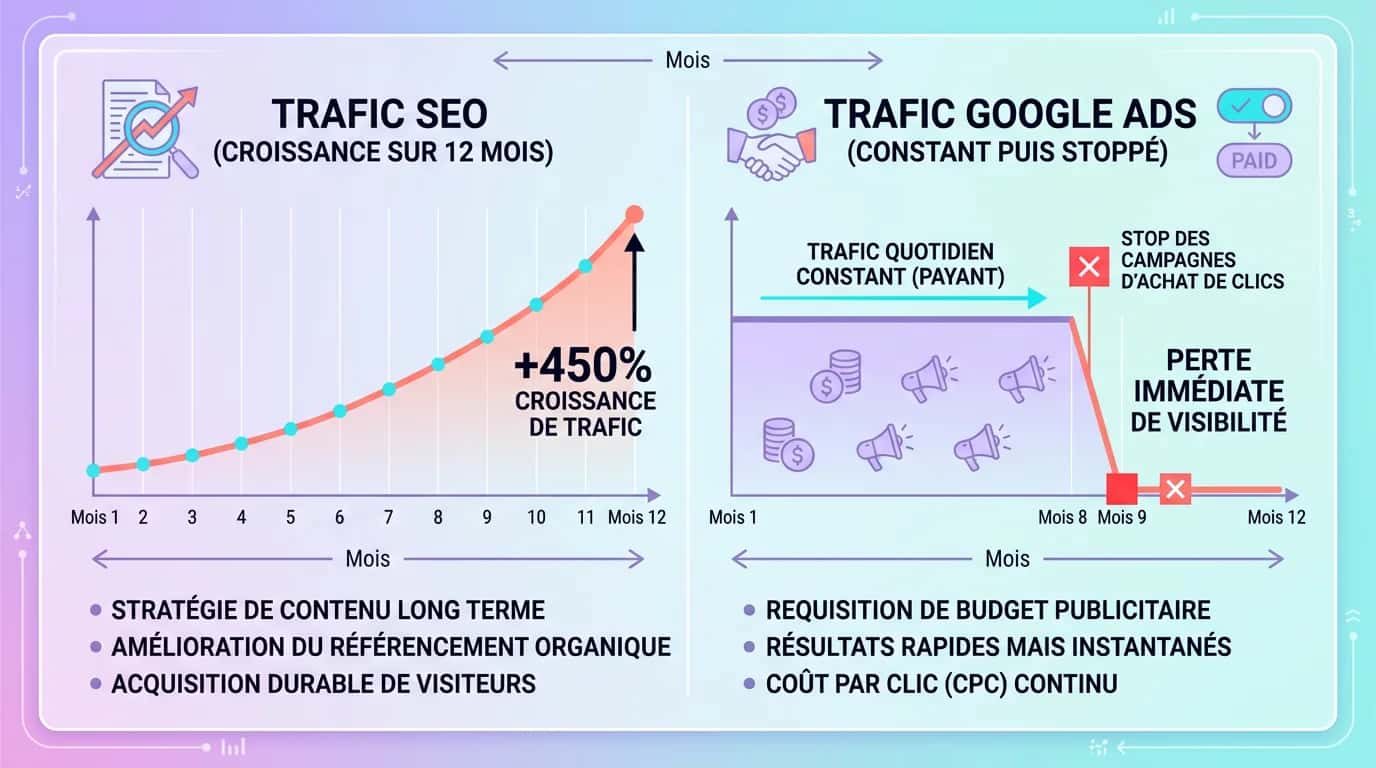
Both strategies have genuine strengths and often-underestimated weaknesses. Neither is perfect. The assessment below is based on public platform data and 2024–2026 industry benchmarks.
The balance varies by sector. A retailer selling seasonal products has different constraints from a B2B consultancy seeking qualified leads all year. Evergreen content favours SEO; precise timing favours Ads. Context and short- to medium-term objectives determine which is stronger.
Cost is often the first concern for a tightly funded SME, but a headline-price comparison misleads. SEO is an investment amortised over time; Ads is a recurring expense that does not compound. The figures below break down the real 2026 cost over 12 and 24 months.
SEO is not free. Doing it internally takes at least 10 to 20 hours a month; outsourcing requires agency or freelance fees. The difference is that SEO’s cost per visit falls as content compounds, whereas Ads CPC remains stable or rises with auction competition. Over 24 months, SEO consistently becomes more profitable for informational and long-tail keywords.
Average observed costs in France (2026)
€1,200/month
Average SME SEO budget with an agency or freelancer
€1,500/month
Median Google Ads budget among French SMEs
€1.20
Average CPC across all French sectors
6–12 months
Average time to positive SEO ROI
SEO spending falls into content creation and on-page optimisation, technical work such as speed, structure, crawlability and markup, and link acquisition. Agencies charge €500 to €3,000 a month depending on website size and competition; a senior freelance SEO charges €400 to €1,500. For a practical continuation, see On-Page SEO Optimisation.
The value appears over time. A page-one article can generate traffic for months or years without extra spend. Across 24 months, SEO cost per visit often falls below €0.10, against an average €1.20 Google Ads CPC. Each euro invested therefore produces more over time and builds an appreciating asset.
On paper, Ads is transparent: every click costs the auction price. Average French CPC is about €1.20 (source: WordStream, 2024), but insurance, legal and finance can reach €15. WordStream also reports annual increases of 5–10%, even in otherwise moderate sectors.
Agency management usually adds 10–20% of ad spend, based on average Google Partner agency rates in France, or a €500 to €1,500 monthly retainer. At €1,500 in monthly media spend, 24 months costs €36,000 in clicks; traffic returns to zero when spending ends.
Practical action: divide total monthly Ads spend, including management, by qualified leads. If the result exceeds €80, rebalance your digital marketing strategy towards SEO.
Traffic alone does not pay bills; signed customers do. Compare qualified-lead cost and signed-customer cost rather than vanity metrics such as impressions, clicks and raw visits.
Google Ads provides conversion data from day one. SEO requires prior configuration in Google Analytics and Search Console, but becomes equally usable. Define the same conversion for both channels — a form, phone call or quotation request — to make a like-for-like comparison.
Three metrics are enough: target-keyword positions in Search Console; qualified organic traffic to strategic pages in Analytics; and organic conversions such as forms, calls and quotations. Average B2B organic traffic converts at around 2.4% (source: FirstPageSage, 2024).
A blog post with 10,000 visits and no conversions is worth less than 200 targeted service-page visits. Track keyword → page → conversion → qualified lead → signed customer to judge SEO and Ads fairly and justify investment.
Native metrics include CTR, CPC, conversion rate and ROAS. Google places average ROAS at roughly 2:1 — €2 in revenue for every €1 spent — but campaign results vary enormously.
Strong campaigns reach 5:1 to 8:1; neglected ones burn budget. Quality Score, negative keywords and landing-page quality make the difference. Our guide to how Google Ads works explains all three.
Practical action: create a cost-per-conversion report by campaign. Keep budget with the small number of campaigns producing most conversions and reduce spend elsewhere.
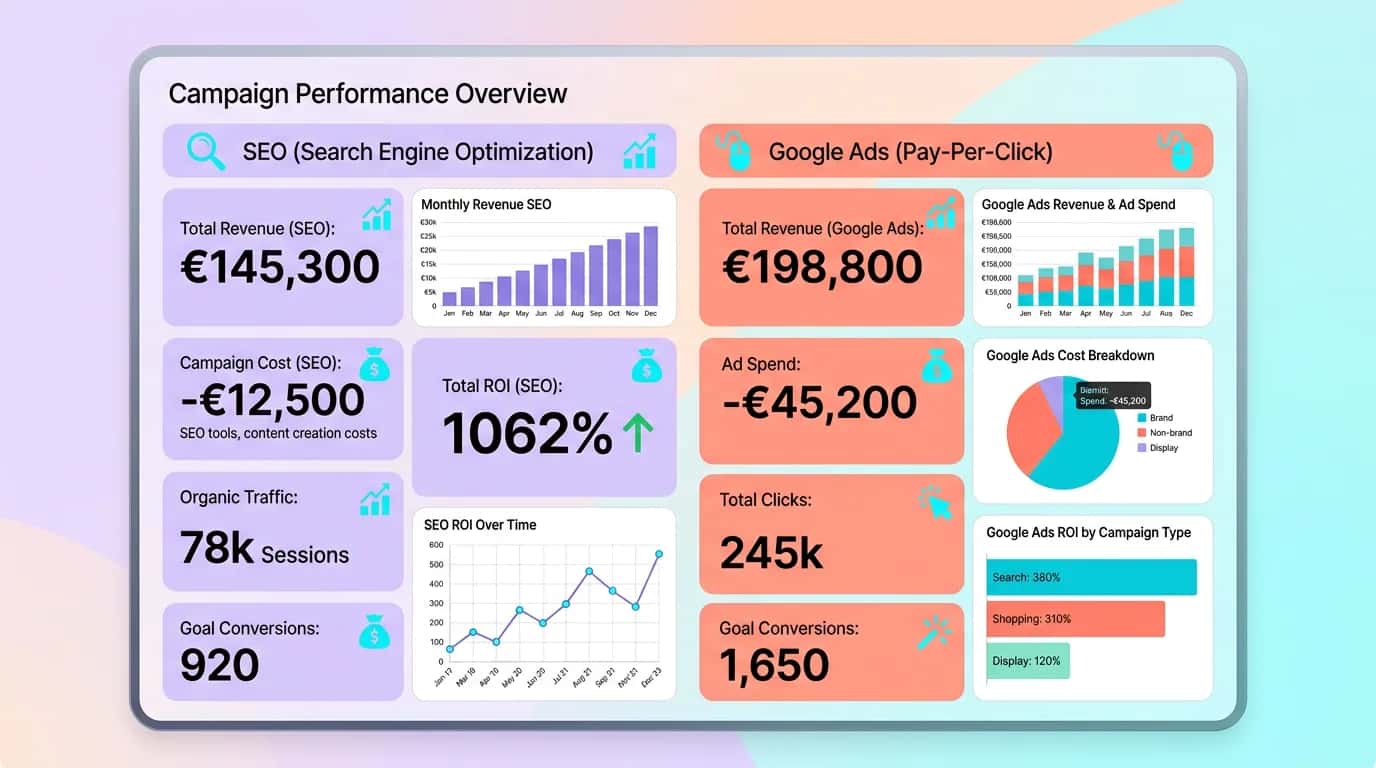
There is no universal answer. The choice rests on monthly budget, timescale and competitive intensity. A local tradesperson with €500 does not have the same needs as a nationwide B2B SaaS company spending €5,000 a month.
The decision guide below reflects real profiles and the top Google results analysed for “google ads vs seo”. Across the four editorial results excluding Reddit, budget and time were the decisive criteria in most cases.
Consider a regional B2B services company with 15 staff and a €1,500 digital budget, seeking 20 qualified leads a month. To take this further, read How to generate leads.
Ads alone, at €2 CPC and a 3% B2B conversion rate (WordStream, 2024), needs about 670 clicks for 20 leads: €1,340 in media, leaving an inadequate €160 for management and no lasting asset.
A blended plan puts €800 into SEO — three articles a month plus technical improvements — and €700 into Ads focused on high-intent terms. By month six, SEO produces 5–8 free organic leads. By month 12, the 20-lead target is met while cost per lead keeps falling.
Four of the top five Google results for “google ads vs seo” recommend combining the channels. It is the rational way for an SME to maximise return while limiting dependence on one source, and generally produces lower acquisition cost than a single-channel approach.
The synergy works both ways. Ads search-term, conversion and CPC data directs SEO towards profitable subjects. In return, strong organic relevance can improve Ads Quality Score and reduce CPC, according to WordStream’s 2024 benchmarks.
Étape 1
Spend €20–30 a day on Search campaigns focused on high-intent commercial keywords. Exclude informational terms and identify the 5–10 most profitable queries in the Search terms report.
Étape 2
Publish two or three articles a month for terms with 200–1,000 monthly searches. Improve speed, URL structure and Schema markup, using Ads conversion data to shape the editorial calendar.
Étape 3
When a keyword reaches the organic top five, reduce or pause its Ads campaign and reallocate the released budget to terms not yet covered by SEO content.
Étape 4
Let SEO supply a growing share of leads while Ads focuses on the highest-intent keywords where organic competition remains too strong. Overall acquisition cost falls as lead volume rises.
Whether you choose SEO, Ads or both, an unclear strategy wastes budget. Most experts in the analysed results recommend a structured blend with a gradual shift. The real question is how to balance the channels for your budget, market and timescale.
The four-phase plan suits most French SMEs spending €1,000–€3,000 a month. Adapt the numbers, but retain the gradual shift from paid to organic: never stop a working channel abruptly; replace it progressively as the lower-cost channel gains strength. Our page on SEO consultant explains the next step.
Our experts assess your current acquisition channels and recommend the right SEO–Google Ads balance for your budget and growth goals.
Explore each channel through our guide to paid search, including auctions, Quality Score and SME optimisation, and our 2026 SME SEO guide for smaller teams with constrained budgets.
To calculate precisely what every new customer costs across SEO, Ads and other channels, read our analysis of customer acquisition cost, with formulas, sector benchmarks and a way to allocate investment between paid and organic acquisition.
Keep exploring
A project in mind?
Start with a free audit grounded in your goals, website and data.
Discutons de votre projet
30 min · Google Meet
Choisissez le créneau qui vous convient dans notre calendrier. On analyse votre situation avant l’appel pour aller droit au but.
Finding available times...