
Refonte

La Refonte insights
Paid search (SEA) offers immediate visibility through Google Ads. Learn how it works, what it really costs, how it compares with SEO and how to launch your first campaign step by step.
Refonte

Google Ads

SEO
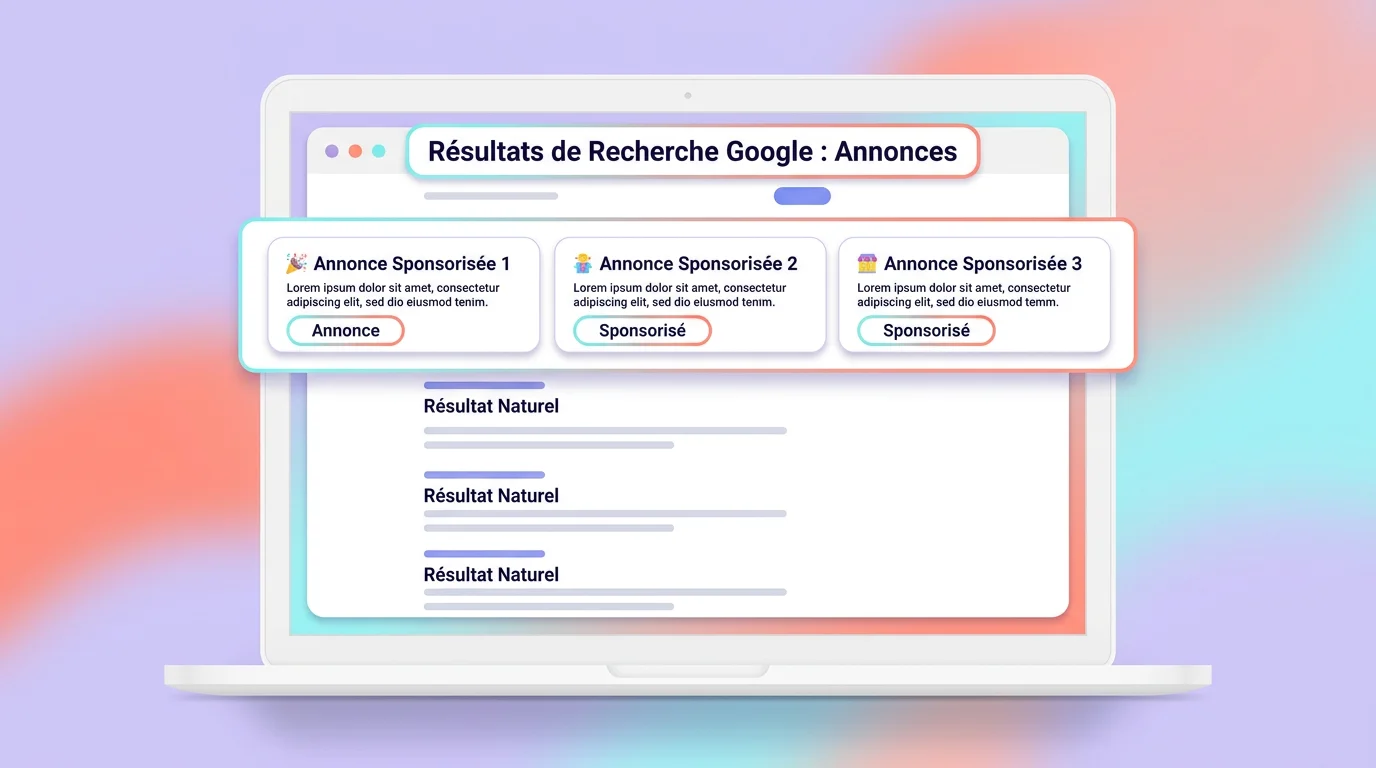
Paid search, also known as SEA (Search Engine Advertising), is the practice of buying advertising space on search engines so that a website appears at the top of results for selected keywords. Unlike SEO, visibility is immediate and directly linked to the advertising budget.
Google accounts for more than 91% of searches in France (source: Statista, 2024), making Google Ads the dominant platform for paid-search strategies in the country. More than 8.5 billion searches are processed worldwide every day, equivalent to 63,000 per second (source: Google, 2024). For an SME that has just launched or redesigned its website, paid search offers a fast way to capture some of this traffic, provided that budget and strategy are carefully managed. This article explains how paid search works, what it really costs and how to use it intelligently alongside a sound organic search strategy.
Paid search in numbers
91%
Google's market share in France (Statista, 2024)
€2
Revenue generated for every €1 invested in Google Ads (Google, 2024)
€0.50–€5
Average CPC range in France (WordStream, 2024)
65%
Ad clicks from searches with strong purchase intent (Semrush, 2024)
The principal difference between organic search (SEO) and paid search (SEA) lies in timescale and cost model. SEO works over the long term: it generally takes three to six months to see the first effects, but positions gained can remain valuable over time. Paid search works in the opposite way: your ads can appear from launch day, but they stop as soon as the budget runs out.
For an SME launching a new offer or running a seasonal campaign, paid search provides a level of responsiveness that SEO cannot match. According to HubSpot (2024), 63% of businesses regard paid search as their main short-term acquisition channel. This is no coincidence: for some competitive keywords, ads occupy the first three or four positions and capture up to 40% of clicks before users reach the organic results (source: WordStream, 2024).
The question is not whether to choose SEO or paid search, but when and how to combine them to generate leads effectively. A well-designed website with a robust SEO architecture will extract more value from paid campaigns because the landing page affects Google Ads Quality Score and therefore your actual cost per click. This is precisely why a well-managed SEO redesign can reduce CPC while improving organic rankings.
| 01Criterion | 02SEO (organic search) | 03SEA (paid search) |
|---|---|---|
| 01Time to results | At least 3–6 months | Immediate (from day one) |
| 02Main cost | Time and technical expertise | CPC budget (pay per click) |
| 03Longevity | Lasting when properly maintained | Active only while the campaign is funded |
| 04Control over traffic | Indirect (Google's algorithm) | Extensive (budget, targeting and schedule) |
| 05Best suited to | Long-term growth | Launches, seasonal demand and rapid tests |
| 06Average CPC in France | No click fee (excluding professional services) | €0.50–€5, depending on the sector |
Time to results
Main cost
Longevity
Control over traffic
Best suited to
Average CPC in France
Étape 1
First, be specific about the result you want: website traffic, phone calls, quote requests or online sales. Google Ads adjusts its bidding algorithms to the selected objective. A lead-generation campaign is not configured in the same way as a brand-awareness campaign. Choosing the wrong objective is one of the most common causes of wasted spend.
Étape 2
Use Google's Keyword Planner to identify relevant keywords, their search volumes and estimated CPCs. Prioritise precise, long-tail phrases with clear intent, such as ‘website redesign agency price’ rather than ‘website redesign’. Add negative keywords from the outset to prevent irrelevant clicks; this is where much wasted budget originates.
Étape 3
Each ad includes three headlines of up to 30 characters and two descriptions of up to 90 characters. The main keyword should appear in the first headline. Enable ad assets such as sitelinks, a phone number and location details to increase click-through rate at no extra cost. Google rewards relevant ads with a stronger Quality Score and therefore a lower CPC.
Étape 4
For an SME, begin with a daily budget of €10–€30, then adjust it according to results. When starting out, a Maximise Conversions strategy with a limited budget can perform well. Avoid manual CPC if you have no historical data; Google's algorithm learns more quickly from live data than you can optimise manually.
Étape 5
After two to four weeks, analyse click-through rate (CTR), cost per conversion and Quality Score. A search-campaign CTR below 2% suggests that the ad needs work. A Quality Score below 5/10 indicates that the landing page is poorly aligned with the keyword, which can send CPC sharply upwards. Continuous optimisation separates a profitable campaign from a wasted budget.
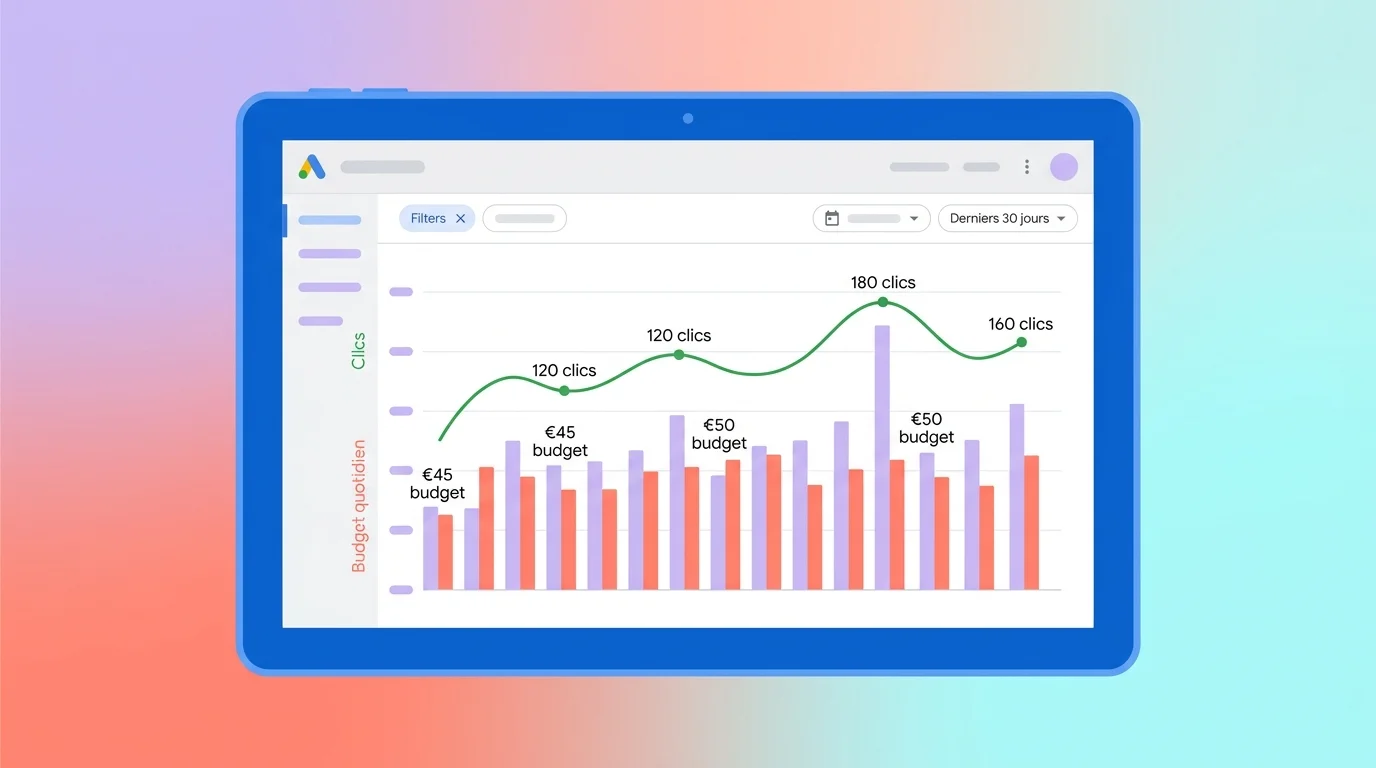
Paid search operates on a cost-per-click (CPC) model: you pay only when someone clicks your ad. The amount depends on competition for the keyword and your Quality Score. In France, WordStream (2024) places the average CPC between €0.50 and €5 in most sectors, although it can exceed €10–€15 for highly competitive terms in fields such as law, finance or healthcare.
An SME starting out should allow a minimum monthly budget of €300–€800 to gather useful Google Ads data. Below that level, the algorithm may lack enough data to optimise bids. Consider a practical example: an IT services provider with a €500 monthly budget focused on precise phrases such as ‘IT support Lyon’ and ‘IT support for SMEs’ could generate 80–150 qualified clicks. With a 5–10% conversion rate on a strong landing page, that represents four to 15 enquiries a month and a cost per lead of €33–€125, depending on landing-page quality and targeting. To manage profitability, measure your overall customer acquisition cost, not CPC alone.
The total cost of paid search may also include campaign management. If you entrust your account to a Google Ads agency, allow an additional €300–€800 a month, depending on campaign complexity. Agencies generally charge 10–15% of managed spend, subject to a fixed monthly minimum. Below a total budget of €1,000 a month for media and management combined, running the account in-house may be more cost-effective.

Online visibility can be divided into three complementary approaches, each with distinct mechanics and use cases. Understanding the differences helps you allocate your marketing budget accurately.
SEO (Search Engine Optimisation) aims to improve a website's position in Google's organic results without paying for each click. It relies on technical website optimisation, content quality and external links, or backlinks. Results take three to six months, but can endure over time. SEO is the long-term foundation of any digital visibility strategy and, according to Ahrefs (2024), pages in first position on Google receive an average 27.6% of all clicks for the query.
SEA (Search Engine Advertising) involves buying advertising space on search engines. Google Ads is the dominant platform in France. Ads appear immediately above organic results with an ‘Ad’ label, and you pay only when somebody clicks. Paid search is well suited to launches, seasonal campaigns and highly competitive keywords for which SEO would take too long to deliver results. For a practical continuation, see google ads agency.
SMO (Social Media Optimisation) covers visibility gained through social networks, whether organically through posts and engagement or through paid advertising such as Facebook Ads and LinkedIn Ads. SMO does not replace SEO or paid search on Google, but complements the overall strategy, particularly when you need to reach audiences that are not yet actively searching for your offer. For some B2B SME sectors, LinkedIn Ads may be more relevant than Google Ads.
Paid search delivers its greatest value when it complements SEO rather than replacing it. According to Google (2024), businesses that combine the two channels receive an average 25% more clicks than those using either one alone. The logic is straightforward: paid search occupies the leading positions while SEO develops over the long term, gradually reducing reliance on advertising spend.
For an SME that has just redesigned its website, the recommended sequence is to begin with paid campaigns for priority keywords, generating traffic and conversions quickly. Use the resulting Google Ads data, including the keywords that convert and the ads with the strongest CTR, to refine your SEO content strategy. Over time, well-optimised articles can take on a greater share of traffic through organic search. Our page on Google Analytics for Your Website explains the next step.
This approach is particularly effective after an SEO redesign: the new website converts more effectively, which improves Google Ads Quality Score and reduces CPC, creating a virtuous cycle. An SEO consultant can coordinate the two channels and identify which keywords deserve priority, based on your sector and available budget.
Last updated: April 2026
A slow, poorly structured or unoptimised website increases CPC and weakens Quality Scores. We audit your website and identify the obstacles to stronger paid-search ROI.
Keep exploring

A project in mind?
Start with a free audit grounded in your goals, website and data.
Discutons de votre projet
30 min · Google Meet
Choisissez le créneau qui vous convient dans notre calendrier. On analyse votre situation avant l’appel pour aller droit au but.
Finding available times...