

SEO

La Refonte insights
A practical guide to generating qualified leads through your website, covering landing pages, content marketing, SEO, advertising and automation.
SEO

Design

Refonte
Lead generation covers all the marketing activity that turns anonymous visitors into identifiable contacts who have provided a name, email address or telephone number and may go on to become customers. An inbound lead costs 61% less than a prospect reached through cold outreach (source: HubSpot, 2024).
Yet 68% of B2B businesses consider lead generation their greatest marketing challenge (source: Demand Gen Report, 2024). Poorly designed landing pages, overlong forms and badly targeted campaigns are expensive mistakes. This guide explains seven practical methods for improving your conversion rate and turning your website into a reliable source of qualified prospects.
Lead generation by the numbers
61%
Lower cost per lead for inbound compared with outbound marketing (HubSpot, 2024)
7x
More leads from businesses with over 30 landing pages (HubSpot, 2023)
3x
More leads from content marketing than traditional advertising (Demand Metric)
14.6%
Close rate for SEO leads, compared with 1.7% for outbound leads (Search Engine Journal)
Lead generation encompasses every strategy used to attract qualified contacts into your sales funnel. A lead is more than an ordinary visitor: it is someone who has shown a concrete interest in your offer by sharing their details, downloading a resource or requesting a quote.
For an SME, the difference between growth and stagnation often lies in the quality of its inbound pipeline. According to Forrester (2024), businesses with a structured approach to lead generation grow their revenue 133% faster than those relying solely on telephone prospecting or unsolicited emails. The principle is simple: instead of continually chasing customers, you build a system that draws them to you.
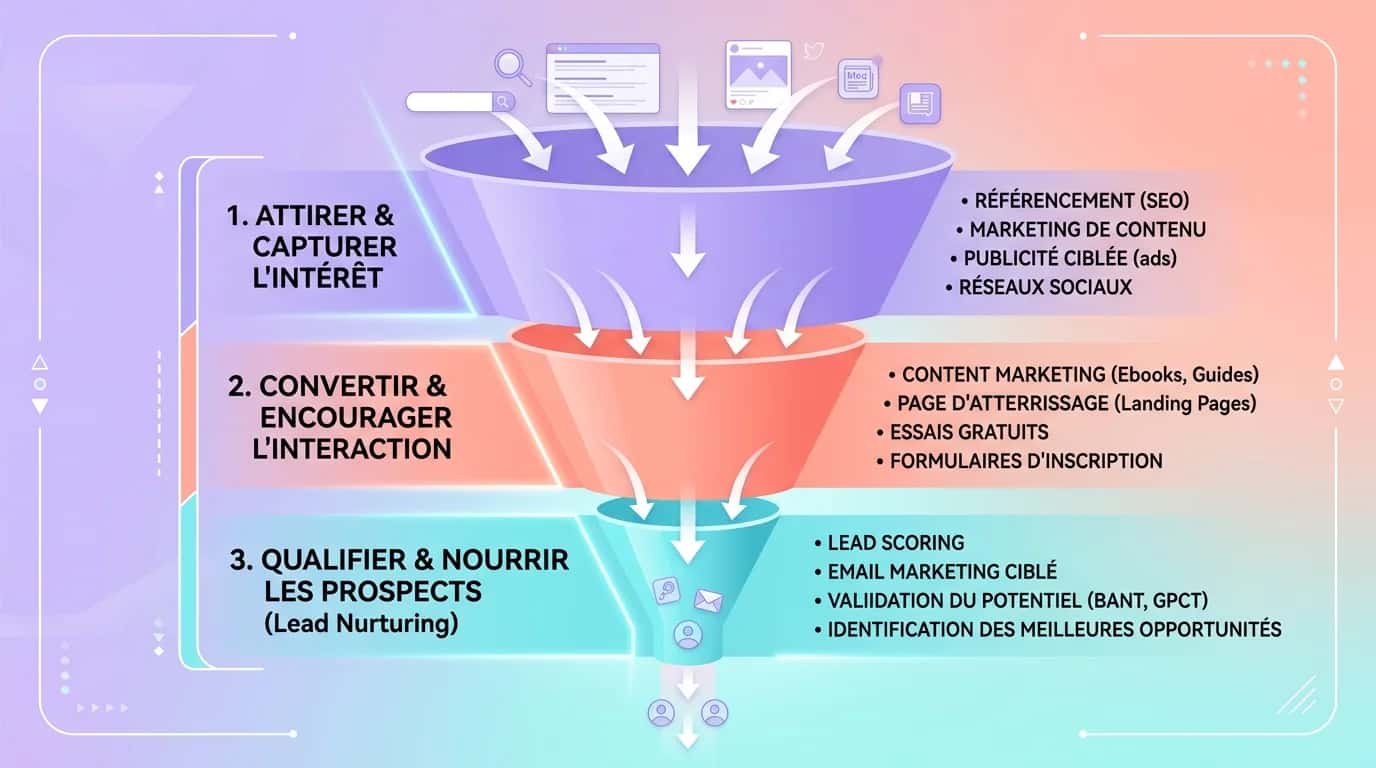
Lead generation has three pillars: attract qualified traffic through SEO, advertising and social media; turn that traffic into identifiable contacts with landing pages, forms and lead magnets; and qualify those contacts so that sales teams receive only the prospects who show genuine interest.
Not all leads are equal. A contact who downloads a white paper does not have the same value as a prospect who requests a quote. Distinguishing between a cold lead, an MQL (Marketing Qualified Lead) and an SQL (Sales Qualified Lead) brings structure to your conversion process and prevents sales teams from wasting time on contacts who are not ready to buy.
A cold lead has shown limited interest, perhaps by joining a newsletter or visiting the website repeatedly. An MQL has taken a more meaningful action, such as downloading a case study, attending a webinar or viewing your pricing page. An SQL has been approved by marketing and expressed a specific need, for example by requesting a quote or booking a discovery call. According to Gartner (2024), businesses that align their MQL and SQL criteria across marketing and sales increase their conversion rate by 36%.
| 01Level | 02Typical action | 03Average conversion rate | 04Sales action |
|---|---|---|---|
| 01Cold lead | Newsletter sign-up, website visit | 1–2% | Automated nurturing |
| 02MQL | Download, webinar | 5–10% | Targeted email sequence |
| 03SQL | Quote request, demo | 20–30% | Direct sales call |
Cold lead
MQL
SQL
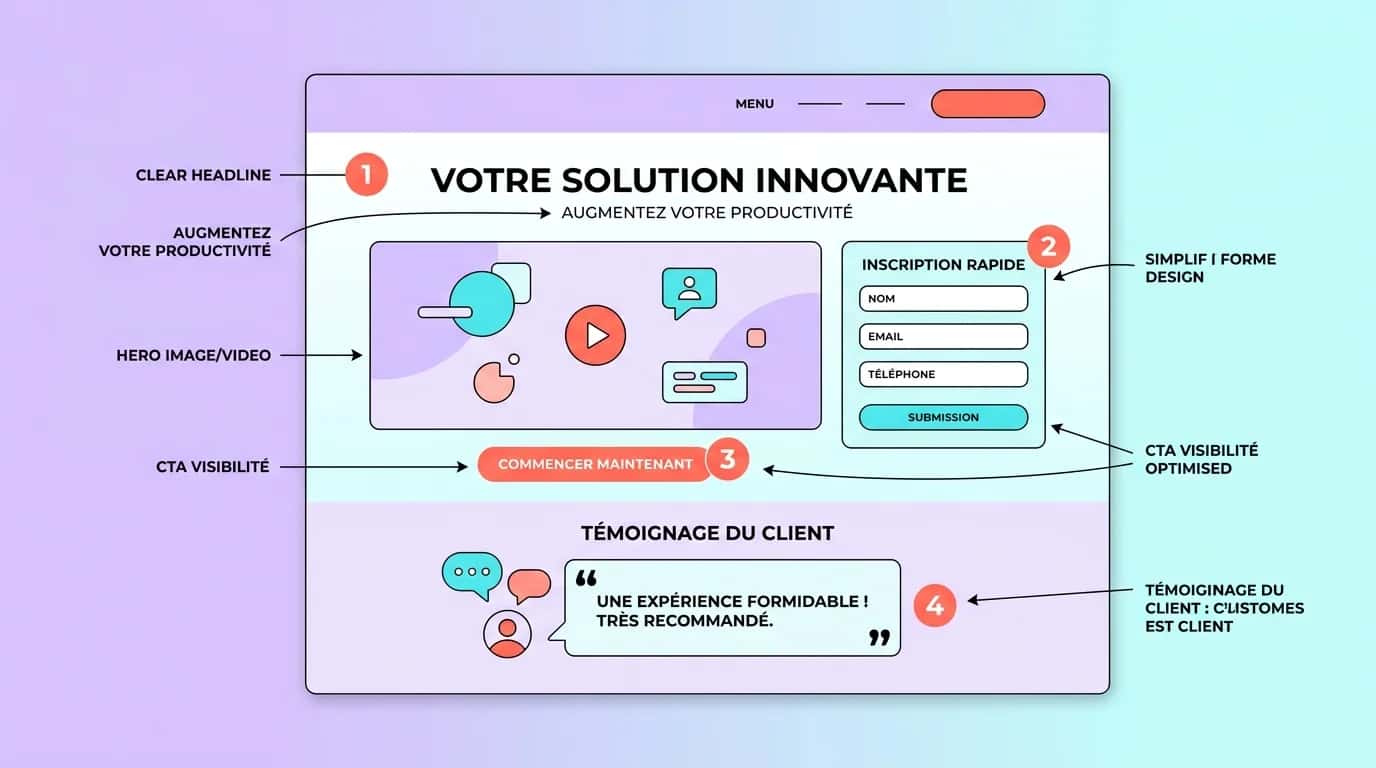
A landing page is the first lever in lead generation. An effective landing page has one purpose: to encourage the visitor to complete a specific action, whether that means submitting a form, downloading a guide or requesting a quote. According to Unbounce (2024), the average conversion rate for a landing page ranges from 2.35% to 5.31%, while the best reach 11% through optimised design.
Businesses that increase their number of landing pages from ten to 15 see leads rise by 55% (source: HubSpot, 2023). Every offer, campaign and customer segment deserves a dedicated page. A form with three fields converts 25% better than one with seven (source: Formstack, 2024). Reducing friction is the golden rule.
Content marketing produces three times as many leads as traditional advertising at 62% lower cost (source: Demand Metric, 2023). The principle is to create useful content that answers prospects' questions, draws them to your website and converts them through lead magnets such as PDF guides, templates, calculators and case studies. For a practical continuation, see Ecommerce Website Redesign.
The key is to align each piece of content with the buyer journey. An informative blog article attracts a cold lead. A technical white paper converts an MQL. A results-led case study persuades an SQL. According to the Content Marketing Institute (2024), 72% of B2B marketers say content marketing significantly increases their volume of qualified leads.
Consider a practical scenario. An HR consultancy in Lyon publishes a guide entitled ‘How to reduce staff turnover in an SME’. The article ranks on Google and attracts 800 visitors a month. By offering a staff-retention plan template in exchange for an email address, the consultancy captures 40 leads each month at almost no cost per lead, compared with €15 to €25 per lead from LinkedIn advertising.
Organic search continues to offer the strongest long-term cost-per-lead ratio. SEO-generated leads have a close rate of 14.6%, compared with just 1.7% for outbound prospecting (source: Search Engine Journal, 2024). SEO reaches prospects at the precise moment they are actively looking for a solution to their problem. Our page on Paid Search (SEA) explains the next step.
To generate leads through SEO, your digital marketing strategy must target keywords with commercial or transactional intent rather than informational searches alone. A contractor searching for ‘construction management software quote’ is far closer to purchasing than someone asking ‘what is an ERP?’. Identify the searches that signal buying intent and create optimised content around them.
Technical SEO also has a direct effect. A website that takes more than three seconds to load loses 53% of its mobile visitors (source: Google, 2023). Optimising Core Web Vitals, structuring H1 and H2 headings and earning high-quality backlinks are prerequisites for reaching the first page, where 91% of clicks take place (source: Ahrefs, 2024).
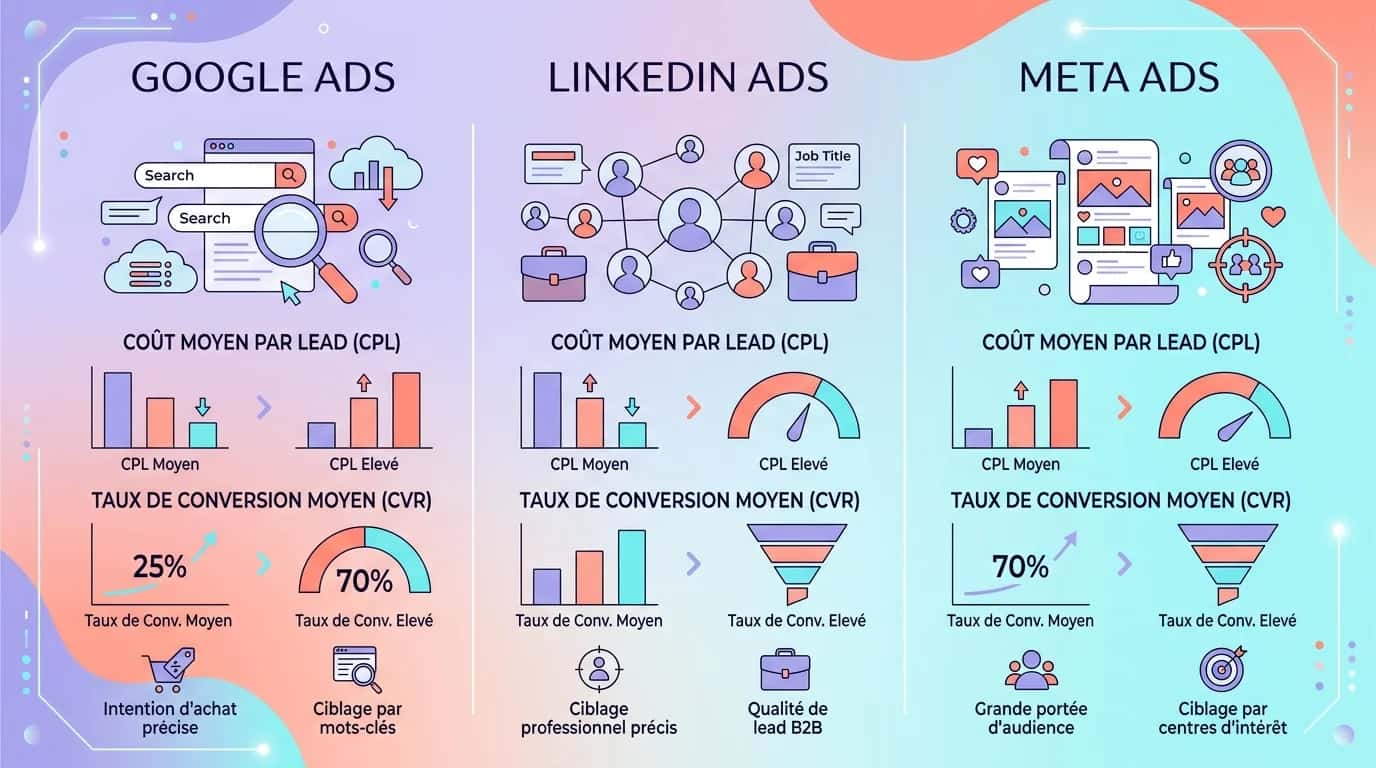
Paid acquisition through Google Ads, LinkedIn Ads and Meta Ads can generate leads quickly, unlike SEO, which takes three to six months to gain momentum. According to WordStream (2024), the average Google Ads cost per lead ranges from €21 to €60 depending on the sector, while Search campaigns have an average conversion rate of 4.4%.
Display advertising, including banners and pre-roll video, supports brand awareness but generates relatively few direct leads, with an average conversion rate of 0.57%. Search captures active intent. LinkedIn Ads costs more, with an average CPL of €75, but offers precise B2B targeting by job title, sector and company size. Meta Ads remains the least expensive channel for B2C, with an average CPL of around €12 (source: Revealbot, 2024).
For an SME with a limited budget, the most profitable strategy combines Google Ads on high-intent keywords with Meta retargeting to re-engage visitors who did not complete the form on their first visit. To take this further, read SEO in 2026.
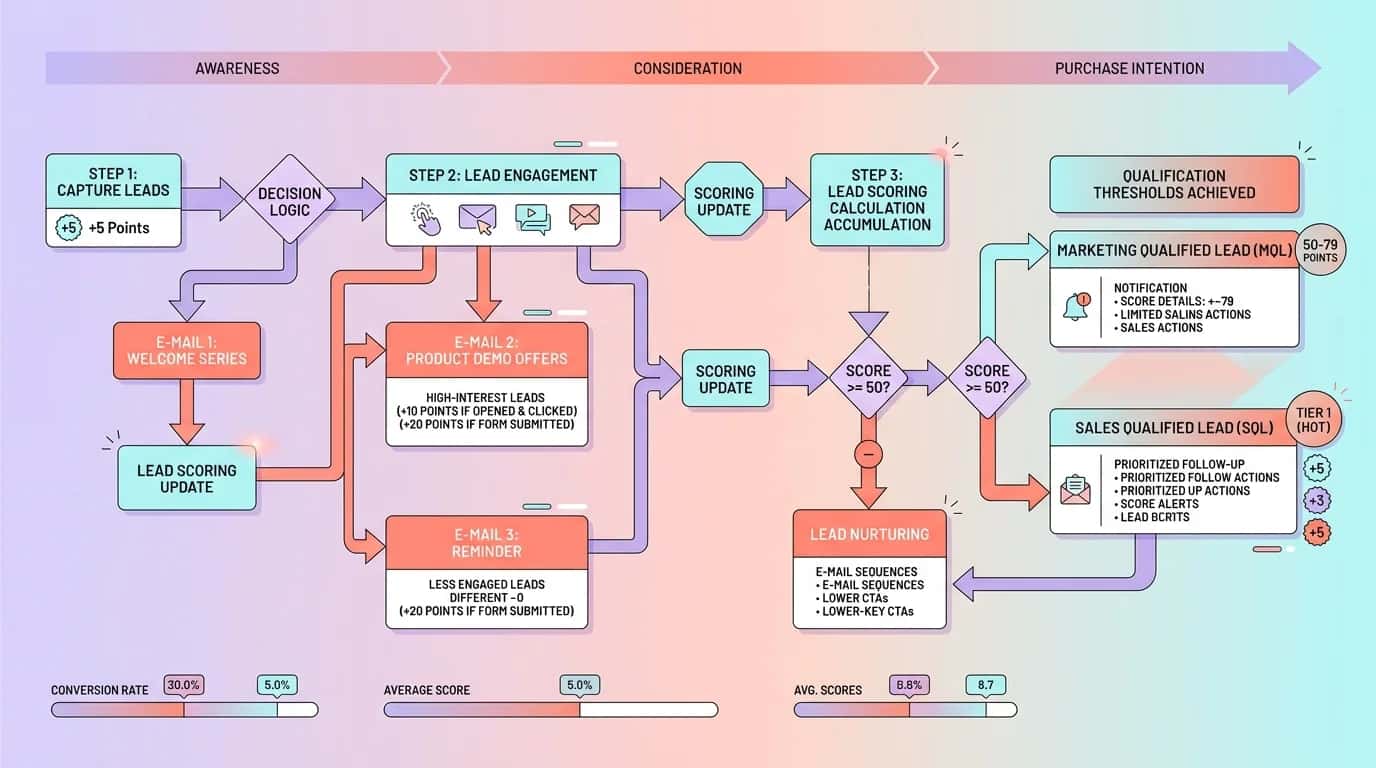
Marketing automation turns a stream of raw leads into qualified prospects without manual intervention. According to Annuitas Group, businesses that automate lead nurturing see a 451% increase in qualified leads. Every lead enters an automated sequence that guides them towards a purchase decision.
Lead scoring assigns points to each action a prospect takes: five points for opening an email, 15 for downloading a case study and 30 for visiting the pricing page. Once the score passes a defined threshold, such as 50 points, the lead automatically becomes an SQL and a salesperson receives a notification. This approach reduces the sales cycle by an average of 23% (source: Marketo, 2024).
Tools such as HubSpot, Brevo, formerly Sendinblue, and ActiveCampaign make these sequences accessible without technical expertise. For an SME generating 50 to 200 leads a month, the monthly investment of €30 to €100 pays for itself as soon as it converts one additional customer. For a practical continuation, see SEO Studio.
Étape 1
The visitor completes a form on your landing page in exchange for a lead magnet. They enter your CRM with an initial score of ten points.
Étape 2
Automatically deliver the promised resource and introduce your expertise. Target open rate: 50–60%.
Étape 3
Send a series of three or four emails featuring blog articles, case studies and testimonials. Each interaction adds points to the lead score.
Étape 4
Send a comparison, ROI calculator or free audit offer. A lead who clicks reaches the SQL threshold.
Étape 5
Pass the qualified lead to a salesperson with their complete history, including pages viewed, resources downloaded and score. The salesperson can then call with the right context.
You cannot optimise what you do not measure. Lead-generation KPIs fall into two groups: marketing metrics covering volume, quality and cost, and sales metrics covering conversion rate, sales cycle and revenue per lead. According to Salesforce (2024), businesses that measure CPL systematically by channel reduce acquisition costs by 30% within 12 months.
Cost per lead is the headline metric. It varies by channel: €15 for mature SEO, €35 for Google Ads and €75 for LinkedIn Ads. Yet CPL alone is not enough. A €75 lead that becomes a €10,000 customer is worth more than a €5 lead that never buys. The LTV-to-CAC ratio, which compares customer lifetime value with acquisition cost, should remain above 3:1 to ensure profitability (source: Bessemer Venture Partners).
Create a monthly dashboard that tracks lead volume and CPL by channel, MQL-to-SQL conversion, SQL-to-customer conversion and revenue by source. Google Analytics, combined with your CRM, provides this data without another tool.
| 01KPI | 02Formula | 03Average benchmark | 04Target for a high-performing SME |
|---|---|---|---|
| 01Cost per lead (CPL) | Channel budget / Number of leads | €25–€60 | < €30 |
| 02Visitor-to-lead conversion rate | Leads / Visitors × 100 | 2–5% | > 5% |
| 03MQL-to-SQL conversion rate | SQLs / MQLs × 100 | 13% | > 20% |
| 04SQL-to-customer conversion rate | Customers / SQLs × 100 | 20–25% | > 30% |
| 05LTV/CAC | Customer lifetime value / Acquisition cost | 3:1 | > 5:1 |
Cost per lead (CPL)
Visitor-to-lead conversion rate
MQL-to-SQL conversion rate
SQL-to-customer conversion rate
LTV/CAC
“Before we structured our lead generation, we relied entirely on word of mouth. Since introducing dedicated landing pages and a nurturing sequence, we receive between 30 and 45 qualified leads a month without outbound prospecting.”
Our specialists analyse your conversion funnel and identify the most profitable opportunities in your sector. Request a free audit of your acquisition strategy.
Last updated: April 2026
Keep exploring
A project in mind?
Start with a free audit grounded in your goals, website and data.
Discutons de votre projet
30 min · Google Meet
Choisissez le créneau qui vous convient dans notre calendrier. On analyse votre situation avant l’appel pour aller droit au but.
Finding available times...

Turn social media into a lead-generation channel
Social media is useful for far more than publishing branded content. Used strategically, it becomes a lead-generation channel in its own right. According to Sprout Social (2024), 78% of businesses using social selling generate more leads than those that do not. To take this further, read AI Assistants.
LinkedIn remains the leading B2B network: 80% of B2B leads from social media originate on LinkedIn (source: LinkedIn Business, 2024). The method is to publish expert content through posts, carousels and articles, engage in conversations involving your target audience, then direct interested readers to a landing page with a relevant lead magnet. Instagram and Facebook work better for B2C and local services. A personal trainer, restaurant or tradesperson, for example, can generate leads through stories that link to a booking form.
Webinars are particularly powerful lead-generation tools. A well-promoted webinar attracts between 100 and 500 registrations, with an average attendance rate of 40% (source: GoToWebinar, 2024). Every attendee provides an email address and becomes a qualified lead who has demonstrated strong interest in your area of expertise.