

Design

La Refonte insights
A successful ecommerce website redesign requires method and discipline. Discover the seven essential steps for turning your online store into a conversion engine without losing your search rankings.
Design

WooCommerce

SEO
An ecommerce website redesign is the complete or partial reconstruction of an online store to improve its performance, user experience, search visibility and design. It becomes necessary when the website no longer converts effectively, loads too slowly or no longer reflects the brand's strategy.
For most online retailers, deciding to redesign is difficult. The risk of losing organic traffic during the transition, the required investment and the fear of disrupting existing sales are all genuine concerns. A structured method can prevent them. According to Google/Deloitte (2021), improving load time by 0.1 seconds increases conversions on retail websites by 8%. That figure alone can often justify the investment. For a practical continuation, see Website Structure.
A redesign is not simply a visual update. It is an opportunity to reconsider the information architecture, optimise buying journeys and meet the changing expectations of mobile shoppers. Unlike the redesign of a brochure website, improving the conversion rate is the primary objective here: every fraction of a percentage point gained translates directly into revenue.
Ecommerce redesign in figures (2026)
70.19%
Average global basket abandonment rate (Baymard Institute, 2024)
+8%
Increase in conversions from a 0.1-second improvement in speed (Google/Deloitte, 2021)
3.2x
Average return from a well-managed ecommerce redesign
36%
WooCommerce share of online stores worldwide (BuiltWith, 2025)
The question is not whether you should redesign, but when. An ecommerce website ages quickly: UX standards evolve, Google's algorithms change and expectations on mobile keep rising. According to Forrester Research (2023), 89% of consumers move to a competitor after a poor online experience. That figure should concern any retailer whose bounce rate exceeds 60%. Our page on Website Redesign Checklist explains the next step.
The most common triggers for a redesign are practical: management asks for a new visual identity, a mobile-first approach becomes essential, the business migrates from PrestaShop to WooCommerce to reduce maintenance costs, or the conversion rate remains below 2% while competitors achieve 3% to 4%. In each case, the right answer is a structured redesign rather than a superficial facelift. Our page on PrestaShop explains the next step.
One word separates a successful redesign from one that loses 40% of its organic traffic: method. The stages of a website redesign must be planned in the right order, without skipping critical SEO work. That is exactly what this guide explains.
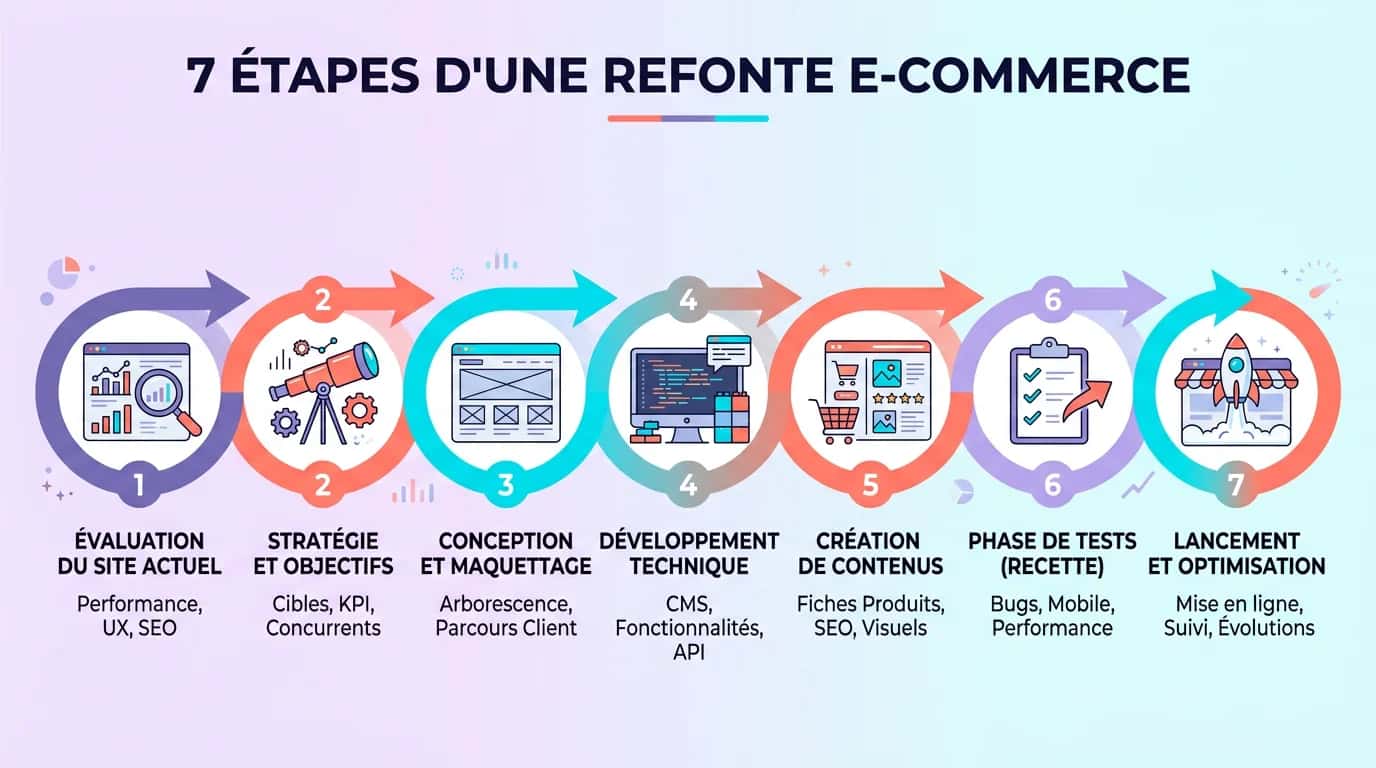
Étape 1
Analyse your current metrics in Analytics, Search Console and heatmaps. Identify the pages that convert, the pages that create friction and everything that must be preserved, especially existing URLs and pages that already rank in Google. A serious audit takes one to two weeks and shapes every stage that follows.
Étape 2
Turn every identified problem into a measurable objective: 'increase the conversion rate from 1.8% to 3%', 'achieve an LCP below 2.5 seconds' or 'reduce basket abandonment by 20%'. The project specification defines the technical, functional and design scope. It is the contractual document that prevents the budget from drifting.
Étape 3
WooCommerce, PrestaShop, Shopify or Magento? The answer depends on the size of your catalogue, the level of customisation you need, your maintenance budget and your existing ecosystem. For 80% of French SMEs, WooCommerce offers the best balance of flexibility and cost, particularly when the business already has a WordPress website.
Étape 4
Start with wireframes, then move to visual mock-ups. Design decisions should come from behavioural data such as heatmaps and session recordings, not aesthetic preferences. Prioritise the mobile buying journey from product page to basket and checkout. Remove every identified point of friction before development begins.
Étape 5
Carry out development in a staging environment, never in production. Integrate the theme first, followed by essential plugins and then business features such as stock management, payment and delivery. Test each module independently before integration. Allow a two- to three-week buffer for unexpected technical work.
Étape 6
Run full functional tests: the buying journey on every device, real payments by bank card and PayPal, email confirmations, stock management and returns. Test performance with PageSpeed Insights and GTmetrix. Test SEO by checking every 301 redirect, meta tag and the XML sitemap. Do not launch until every point has been approved.
Étape 7
On launch day, switch the DNS during a quiet period, ideally overnight. Check the redirects immediately and submit the sitemap to Search Console. The next 72 hours are critical: monitor traffic, 404 errors and conversions in real time. Prepare a rollback plan in case a serious issue appears. During the first week, analyse the data and make rapid corrections.


| 01Platform | 02Market share | 03SME redesign cost | 04Strengths | 05Limitations |
|---|---|---|---|---|
| 01WooCommerce | 36% worldwide | €3,000-€12,000 | Complete flexibility, WordPress ecosystem and strong native SEO | Requires regular technical maintenance |
| 02PrestaShop | 12% worldwide | €4,000-€15,000 | Complex catalogues, B2B and multiple stores | Cumbersome back office and expensive modules |
| 03Shopify | 10% worldwide | €2,500-€8,000 | Easy to manage, hosting included and 24/7 support | Limited customisation and transaction fees |
| 04Magento/Adobe | 2% of SMEs | €15,000-€50,000 | High capacity and enterprise-grade capabilities | Prohibitive complexity and cost for SMEs |
WooCommerce
PrestaShop
Shopify
Magento/Adobe
Every millisecond matters on an ecommerce website. Baymard Institute (2024) analysed 4,000 ecommerce websites and found that stores with the best checkout UX convert up to 35% better than the industry average. Three technical factors dominate: load speed, the simplicity of the mobile buying journey and the clarity of product pages.
Speed can be measured and improved. Strong Core Web Vitals, with LCP below 2.5 seconds, FID below 100 milliseconds and CLS below 0.1, have been essential since Google incorporated these signals into its ranking algorithm in 2021. Across the redesign projects we support, moving to a lightweight theme, advanced caching and WebP images consistently improves PageSpeed scores by 40 to 70 points.
The checkout UX deserves particular attention. According to Statista (2024), 26% of abandoned baskets are caused by a purchasing process that is too long or complex. Practical solutions include reducing checkout to a single page wherever possible, allowing guest checkout without compulsory account creation and showing delivery charges clearly on the product page. These are not assumptions. They are measurable levers that every serious ecommerce developer should include from the design stage.
Case 1, independent jewellery business in Bordeaux (12 employees): migration from PrestaShop 1.7 to WooCommerce in eight weeks. The conversion rate rose from 0.9% to 3.1% in six months, generating an additional €54,000 in annual revenue. The decisive factor was the mobile checkout redesign, which reduced five stages to one page, combined with VPS hosting and WP Rocket. To take this further, read prestashop redesign.
Case 2, outdoor equipment retailer in Lyon (eight employees): migration from Shopify to WooCommerce with a new mobile-first design. Before the redesign, 71% of sessions came from mobile but produced only 22% of conversions. Four months afterwards, mobile accounted for 61% of conversions. The original causes were a delivery form unsuited to a touchscreen keyboard and uncompressed images averaging 3 MB. Development changes, WebP images and a simplified checkout produced a 3.8x return in ten months. To take this further, read woocommerce agency.
These two examples illustrate a consistent rule: the greatest gains come not from visual design but from technical performance and a simpler buying journey. Appearance attracts; UX and speed convert.

Most unsuccessful redesigns share the same mistakes. Identifying them before work begins can prevent months of remedial effort. McKinsey (2022) estimated that 60% of digital transformation projects fail to meet their objectives, primarily because of poor project management and ill-defined goals. That finding applies directly to ecommerce redesigns.
Missing 301 redirects create 404 errors that can cut traffic by 20% to 40% in the weeks after launch. The solution is to map every URL before work begins.
Everything should be tested on a staging URL for two to four weeks. Testing directly in production exposes customers to critical defects.
More than 60% of ecommerce purchases take place on mobile. When the design starts with desktop, mobile will always become a compromised adaptation.
Products, customers, historical orders and reviews each have their own formats and validation rules. A rushed migration creates stock inconsistencies and broken baskets.
Your customers are not the same as your competitors' customers. Your heatmaps and session recordings are much more valuable than the design of a competitor whose website may convert less effectively than yours.
The first 30 days after launch are critical. Daily monitoring of conversions, 404 errors and search rankings lets you correct issues before they become more serious.
Improving the checkout UX to industry best practice could increase e-commerce conversion rates by 35.26% on average.
With 36% of the global online-store market (BuiltWith, 2025), WooCommerce is not simply the default option. It is a strategic choice. For French SMEs with catalogues ranging from 10 to 5,000 products, no other combination offers the same balance of flexibility, cost control and technical independence. For a practical continuation, see WooCommerce.
The practical advantages during a redesign include its mature plugin ecosystem, with native integrations for Stripe, Colissimo, PayPal and Klarna; complete compatibility with leading SEO tools such as Yoast and Rank Math; and the freedom to customise every part of the buying journey without depending on a Shopify provider or paid PrestaShop modules. For a store with 500 products, our experience suggests that annual WooCommerce maintenance costs 40% less on average than PrestaShop. To take this further, read How to Choose a CMS in 2026.
Our WordPress ecommerce redesign service systematically includes lossless data migration, performance optimisation with a guaranteed PageSpeed score above 75 and complete 301 redirects. The typical delivery time is six to ten weeks, depending on the project's complexity.
“We had been stuck on PrestaShop for four years and could not change the website without calling a provider. The WooCommerce redesign transformed the situation: we now manage everything independently, and our conversion rate rose from 1.4% to 2.9% in five months. The investment paid for itself within seven months.”
A complimentary audit of your current website covering performance, SEO, UX and checkout. Together, we identify the three levers most likely to double your conversions before discussing the budget.
Last updated: April 2026
Keep exploring


A project in mind?
Start with a free audit grounded in your goals, website and data.
Discutons de votre projet
30 min · Google Meet
Choisissez le créneau qui vous convient dans notre calendrier. On analyse votre situation avant l’appel pour aller droit au but.
Finding available times...