

Refonte

La Refonte insights
Compare five SEO Studio platforms and apply a five-step method for prioritising pages without depending on paid software.
Refonte

SEO

IA
What are SEO Studio tools? They combine technical auditing, keyword research, Google rank tracking and page analysis in one platform. An SEO Studio serves SME owners, marketing teams, freelancers and agencies that need to detect problems and measure corrections. It does not replace a method: someone still has to decide which pages to work on and in what order.
An SEO Studio is an online platform that brings together several tools for analysing and improving organic search performance. These software suites let you audit a website, identify valuable keywords and track Google rankings without installing software on your computer.
According to Statista (2025), 68% of online experiences begin with a search engine. For an SME, choosing the right SEO Studio directly affects visibility and customer acquisition. Several platforms compete in this market, including SEOStudio Tools, SEO Studio France, Semrush, Ahrefs and SE Ranking. This article compares their features, explains their practical limitations and sets out the professional method for turning raw data into tangible technical SEO results.
The term SEO Studio covers platforms that centralise the tools required for organic search optimisation within a single interface. Three main categories could be found in the French-speaking market in 2026 (source: Semrush, 2025).
Free online suites such as SEOStudio Tools provide dozens of basic utilities, including backlink checkers, keyword analysers and page-speed tests. Their business model relies on advertising or freemium access. Specialist platforms such as SEO Studio France target specific niches, in this instance Etsy sellers, with tools for optimising titles, descriptions and tags for a particular marketplace.
Professional suites such as Semrush, Ahrefs and SE Ranking provide much deeper analysis: 24 months of ranking history, comprehensive competitor analysis and automated technical audits with more than 130 checks. According to Ahrefs (2025), 96.55% of web pages receive no traffic from Google, demonstrating that tools alone are not enough without an underlying strategy.
SEO in figures for 2026
68%
of online experiences begin with a search engine (Statista, 2025)
53%
of all web traffic comes from organic search (BrightEdge, 2024)
75%
of users do not go beyond Google's first page (Backlinko, 2024)
14.6%
average conversion rate for SEO leads, versus 1.7% for outbound (HubSpot, 2024)
A complete SEO Studio should cover the five pillars of organic search. Each feature addresses a specific need within the optimisation process. A 2025 Semrush study of 1,200 marketing professionals found that businesses using at least three of these features together gain 2.7 times more organic traffic than those relying on a single tool.
The difference between a basic SEO Studio and a professional suite lies in the depth and freshness of its data. A free tool may update its data weekly at best, while a suite such as Ahrefs crawls eight billion pages a day (source: Ahrefs, 2025). For an SME investing in SEO with appropriate tools, that difference directly affects its ability to respond to algorithm changes.
Automated scans for 404 errors, broken redirects, missing tags and indexing problems. Reveals technical obstacles that would otherwise remain hidden.
Monthly search volume, ranking difficulty, long-tail suggestions and search-intent analysis.
Daily monitoring of your Google rankings for target keywords, with alerts for significant drops.
An inventory of inbound links, authority scores for referring domains and detection of toxic links that may need to be disavowed.
Recommendations for title tags, meta descriptions, heading structure and keyword density on each page.
Compare your SEO profile with direct competitors: shared keywords, traffic gaps and opportunities.
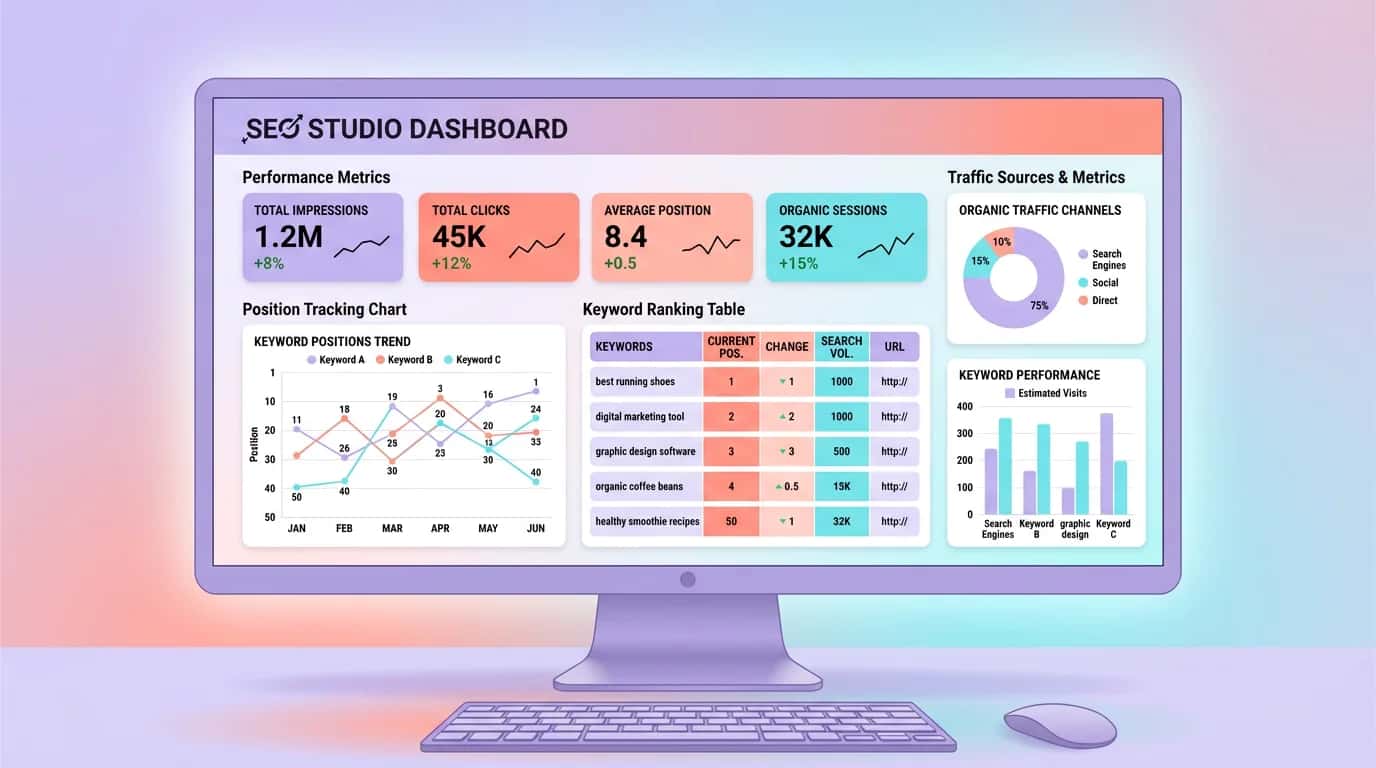
The market is divided between free utilities and subscription-based professional suites. To choose a platform, compare data depth with the monthly budget and the time available to act on reports.
The table retains the five solutions already covered on this page. An SEO specialist can help turn the data into a prioritised plan when no one can own that work internally.
| 01Platform | 02Monthly price | 03Tracked keywords | 04Technical audit | 05Best for |
|---|---|---|---|---|
| 01SEOStudio Tools | Free | Not available | Basic (10 checks) | Beginners and occasional checks |
| 02SEO Studio France | Price not published | Etsy only | No | Etsy sellers only |
| 03SE Ranking | $129–$279 | 2,000–5,000 | 130+ checks | SMEs with a moderate budget |
| 04Semrush | $139.95–$499.95 | 500–5,000 | 140+ checks | SMEs and agencies |
| 05Ahrefs | £99–£359 | 750–5,000 | 100+ checks | Advanced backlink strategies |
SEOStudio Tools
SEO Studio France
SE Ranking
Semrush
Ahrefs
The right choice depends on available time and on who will make decisions after each report. The table gives one clear route for each situation.
| 01Handle internally | 02Build internal capability | 03Delegate |
|---|---|---|
| 01You check a small website occasionally and can apply straightforward corrections. | The team wants to learn prioritisation and retain the method internally. | The diagnosis spans technical SEO, content or authority and no one can own it. |
| 02Compare SME SEO tools | [Use the five-step method below](#methode-seo-sans-outil-payant) | Request an SEO audit |
You check a small website occasionally and can apply straightforward corrections.
Free utilities support a quick diagnosis, but their limits appear when monitoring becomes recurring. Historical data, competitor coverage, crawl limits and exports may be restricted.
The main limitation is prioritisation. A report can list dozens of issues without identifying the pages that matter first, the person responsible for each correction or the metric used to verify it. That work remains a method, not a software feature.
Price alone does not decide the right tool. Define the number of pages to monitor, publishing frequency, available budget and the person who will act on the data.
A ten-page brochure website does not have the same needs as a shop with 500 product pages. The first may use a free tool and a one-off website audit; the second may need recurring rank tracking, cannibalisation analysis and technical monitoring. If the choice is still unclear, return to the decision table.
Previous traffic, lead and return-on-investment figures are not retained because no published primary source allows them to be checked. The two examples therefore preserve the before-and-after structure and describe only the changes in working method.
For results tied to dated evidence, review La Refonte's published SEO and GEO case studies.
This method uses Google Search Console and data already available on the website. It starts with pages that Google already displays, then checks click-through rate before opening a wider technical or editorial project. Our page on Google Ads vs SEO explains the next step.
Étape 1
In Google Search Console, open the performance report and sort pages by impressions. Isolate those displayed frequently but receiving few clicks. They already have visibility and offer a measurable starting point.
Étape 2
Start with a page already near the leading results and shown often enough to produce data. Record its position, impressions and click-through rate. Work on one page at a time so the correction can be linked to the observed change.
Étape 3
Compare the target query, Google title and meta description. Make the answer and benefit explicit without a vague promise. Rewrite the page only when the corrected title and snippet are not enough.
Étape 4
Record the publication date, then compare click-through rate after 45 days at a comparable position. Keep the same page, queries and equivalent period. Separate a ranking change from the effect of the new snippet.
Étape 5
When several people repeat this work, document the criteria, schedule and responsibilities. The team should know who selects pages, who implements changes and who validates the comparison.
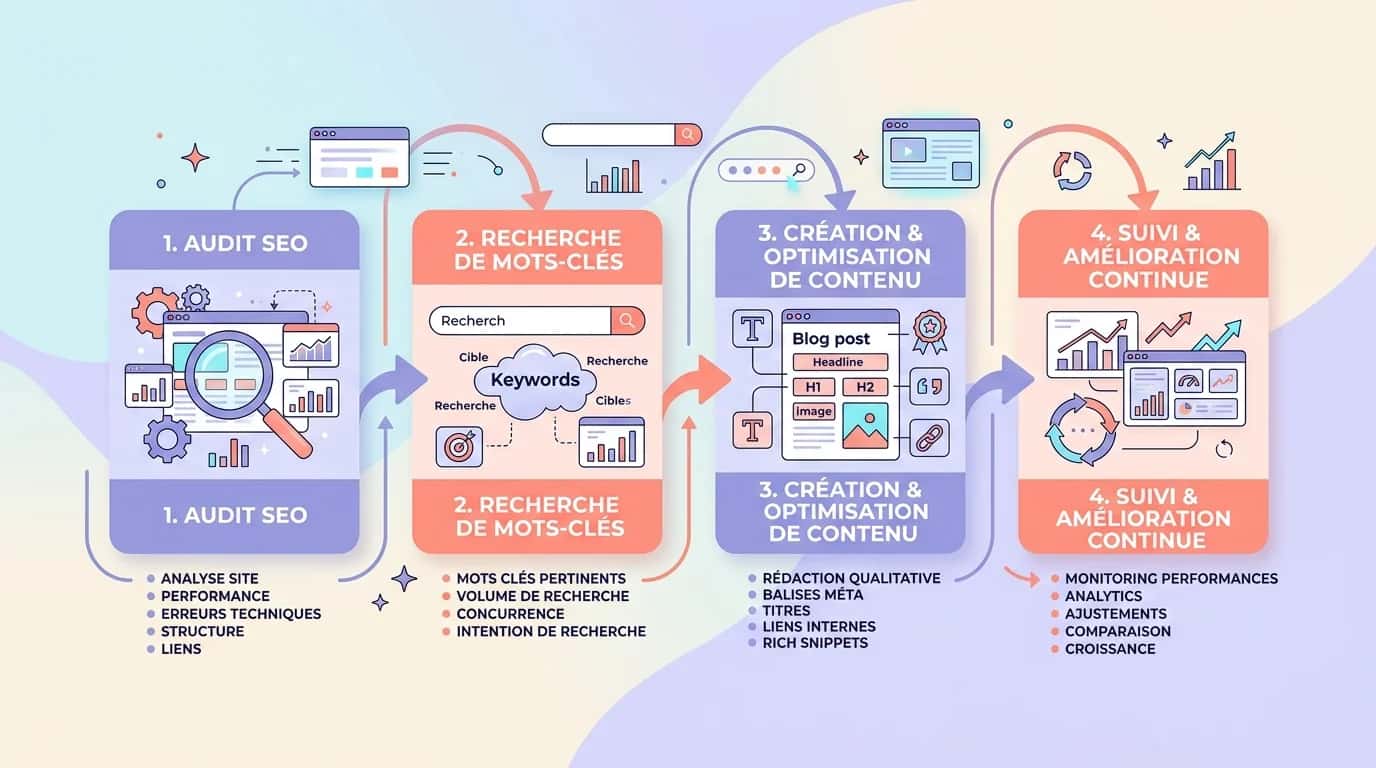
Owning an SEO Studio without a method is like buying a microscope without knowing biology. According to Google (2024), websites that take a structured approach to technical SEO and content gain an average of 3.2 positions for their target keywords within six months. This is the method we use at La Refonte to turn SEO Studio data into measurable on-page SEO improvements.
Étape 1
Run a full crawl of your website through the SEO Studio. Prioritise errors by impact: 404 pages with inbound backlinks, duplicate title tags and unindexed pages. Correct the 20% of problems responsible for 80% of the negative effect.
Étape 2
Export the keywords for which you rank between positions 5 and 20: these are your quick wins. Cross-reference search volume and competition, then assign each keyword to an existing page or plan new content.
Étape 3
Write a 1,500- to 2,500-word article for every priority keyword. Use H2 and H3 headings that reflect users' questions in Google's People Also Ask results. Include figures and verifiable sources to support E-E-A-T.
Étape 4
Configure a dashboard in your SEO Studio to track rankings, organic traffic and conversion rate each week. Adjust your strategy monthly: strengthen content that is improving and rework content that has stalled.
The cost depends on scope. Software combines a subscription with internal time. Building internal capability requires time to document and repeat the method. External delivery assigns analysis and coordination to a specialist. Prices vary with the website and desired autonomy, so use the decision table before requesting a quote.
Move from tool comparison to a documented internal process when the team can generate reports but still hesitates over the order of corrections, content decisions or measurement. Define the owner, acceptance criteria and review date before adding another subscription.
Our specialists analyse your SEO data and turn it into a technical, editorial and measurement plan with named priorities.
Last updated: 24 August 2026
Keep exploring
A project in mind?
Start with a free audit grounded in your goals, website and data.
Discutons de votre projet
30 min · Google Meet
Choisissez le créneau qui vous convient dans notre calendrier. On analyse votre situation avant l’appel pour aller droit au but.
Finding available times...