
Refonte

La Refonte insights
73% of SMEs are missing out on rankings because their on-page SEO is weak. Here are the six levers that genuinely move the needle, plus a ten-point audit checklist to use this week.
Refonte

SEO

IA
The average organic click-through rate for the number-one position on Google.fr is 27.6%, according to Semrush (2025). SMEs that have worked on their on-page SEO reach this threshold.
Those that have not tend to plateau between 8% and 12%. Every month, they lose leads that competitors capture without spending any more on advertising.
If your pages rank well but attract few clicks, or earn clicks but few conversions, your on-page optimisation is incomplete.
This guide sets out the six on-page SEO levers that directly affect Google rankings, using figures observed on SME websites in France.
It also includes a ten-point audit checklist for diagnosing priority pages in under 15 minutes, with no paid subscription.
The aim is to identify what is holding back your organic visibility and act this week, without waiting for a complete redesign.
Technical SEO covers what crawlers see: speed, URL structure, robots.txt, canonical tags and XML sitemaps.
On-page optimisation covers what people and Google read on the page: the title tag, meta description, heading structure, semantic breadth and internal links.
According to Ahrefs (2024), 61% of pages in the top ten have sound on-page optimisation, compared with 34% of pages ranking between 11th and 30th.
SMEs often invest in the technical side without improving the content. The result is a technically clean website that fails to rank because it lacks semantic signals.
Google published its Quality Rater Guidelines in 2025 with a stronger emphasis on E-E-A-T: Experience, Expertise, Authoritativeness and Trustworthiness.
For an SME, content needs to demonstrate genuine first-hand experience, cite sourced data and prove an insider's understanding of the sector.
Google SGE intensifies this effect, as AI answers draw on sources deemed trustworthy.
A page with no named author, sourced figures or specific examples is less likely to be selected as a reference.
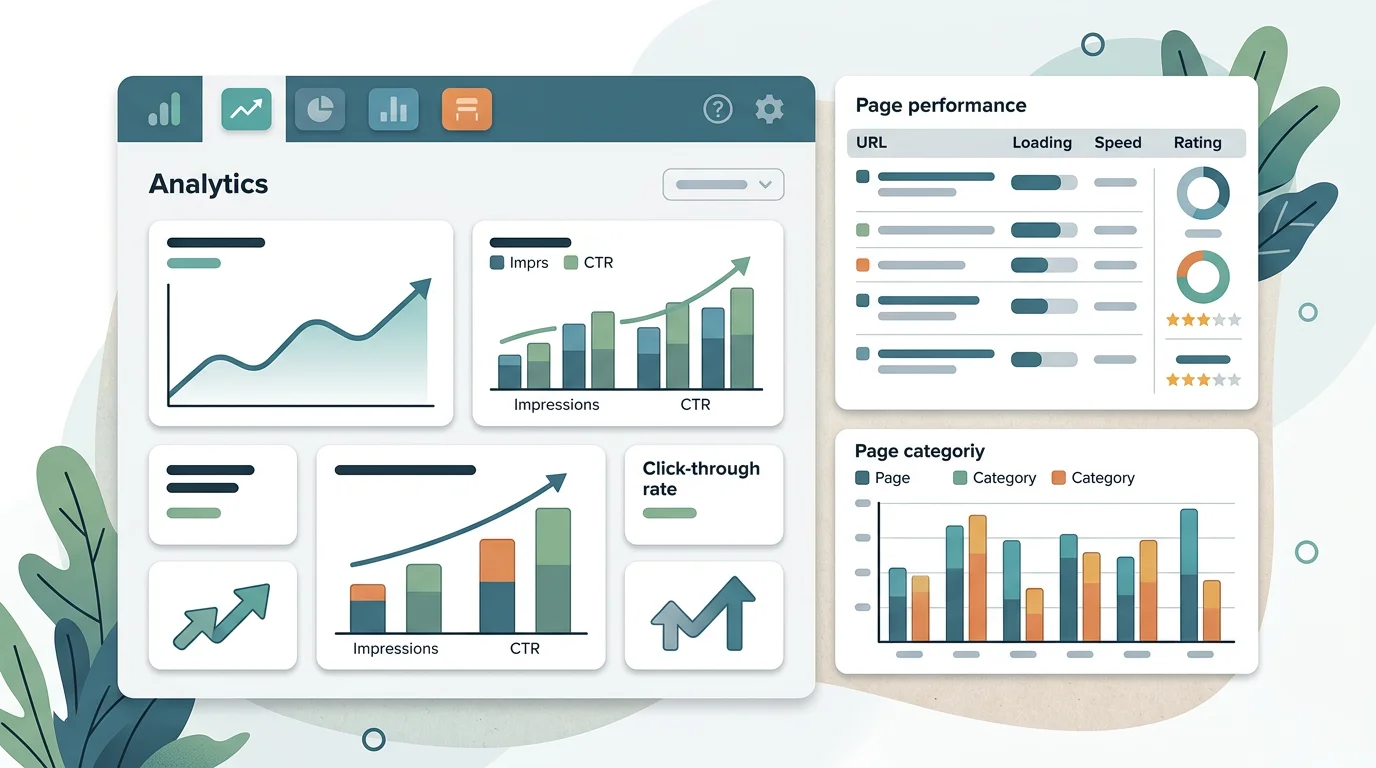
The title tag is the first relevance signal Google reads. Put your main keyword within the first 30 characters and keep the whole title below 60.
The meta description is not a direct ranking factor, but it influences the click-through rate.
According to WordStream (2024), an optimised meta description delivers 15% more clicks on average. At 200 impressions a day, that means 30 extra qualified visits.
The H1, H2 and H3 structure is your content plan for Google. Use one H1 per page, H2s for subtopics and H3s for supporting detail.
This hierarchy helps Google identify the passages most relevant to each search. For a practical continuation, see SEO and GEO.
Every H2 should answer a specific search intent without requiring someone to read the entire article.
An HR consultancy in Lyon rebuilt eight service pages around quantified case studies and author biographies. Organic traffic rose by 34% in four months.
Google expects content to prove first-hand experience through specific examples, sourced figures, a named author and references to real tools.
Google analyses the complete vocabulary of a page, not just repetitions of one keyword. Without related terms, the page may appear superficial.
Pages in the top three use an average of seven semantic variants of their main keyword (Semrush, 2024). Aim for no more than four exact uses in 400 words.
Internal links transfer authority from your best-performing pages to those you want to move up the rankings.
For an SME website with 20 to 50 pages, three to five internal links per article are enough. Our guide to a complete website audit explains how to map these links and find orphan pages.
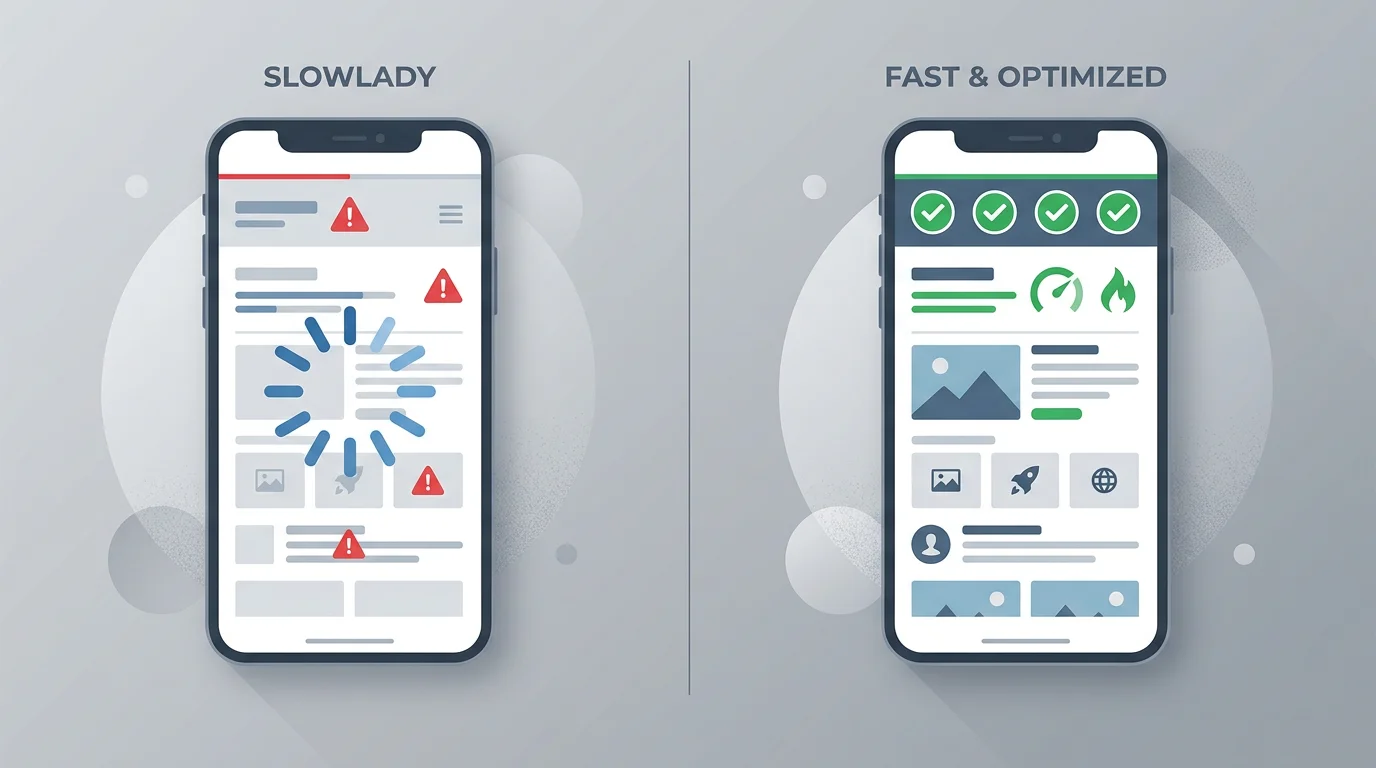
Unoptimised images are the leading cause of poor Core Web Vitals scores, which Google has included in its algorithm since 2021.
A 2 MB image can push LCP beyond four seconds, the critical threshold for rankings.
The fix is to convert it to WebP, reduce it below 150 KB and add descriptive alt text. Our article on Core Web Vitals takes you through the process.
See how your website compares with high-performing SMEs in your sector. To take this further, read Website Structure.
The table below brings together benchmarks observed across French SME websites (Semrush and Ahrefs, 2025).
| 01On-page SEO signal | 02Optimised SMEs (top 30%) | 03Unoptimised SMEs (average) |
|---|---|---|
| 01Organic CTR (positions 1–3) | 18–28% | 8–14% |
| 02Title tag contains the main keyword | 100% | 67% |
| 03Unique, purpose-written meta description | 100% | 43% |
| 04Coherent heading structure (one H1) | 100% | 51% |
| 05Images have alt text | 95% | 38% |
| 06LCP below 2.5 seconds | 78% | 29% |
| 07Internal links (at least three per page) | 87% | 34% |
Organic CTR (positions 1–3)
Title tag contains the main keyword
Unique, purpose-written meta description
Coherent heading structure (one H1)
Images have alt text
LCP below 2.5 seconds
Internal links (at least three per page)
Google Search Console shows each page's real performance, including impressions, CTR and average position, and flags indexing errors.
Ahrefs Webmaster Tools, on its free plan, analyses backlinks and detects major on-page problems.
Yoast SEO for WordPress checks title tags, meta descriptions and keyword density inside the editor. Our page on WordPress SEO explains the next step.
Together, these three tools cover 80% of an SME SEO diagnosis. Our complete guide to SEO tools for SMEs explains the free and paid features of each option if you want to go beyond an initial diagnosis. Start by sorting pages by ascending CTR in Search Console.
In Search Console, the Performance → Pages report reveals your opportunities. Sort by impressions in descending order.
Find pages with more than 500 monthly impressions and a CTR below 5%. These are your greatest untapped opportunities.
The priority fix is almost always the title tag and meta description.
A furniture shop in Bordeaux gained 22% more organic traffic in six weeks by rewriting the titles and meta descriptions of 12 pages (Search Console, 2024).
SEO improvements have limits. If your content no longer matches current search intent, adjusting tags will not be enough.
Three signs point to a content redesign: traffic has fallen for more than six months; transactional pages have a bounce rate above 75%; or the content is more than two years old.
In these cases, a structured website redesign produces far better results than superficial tweaks.
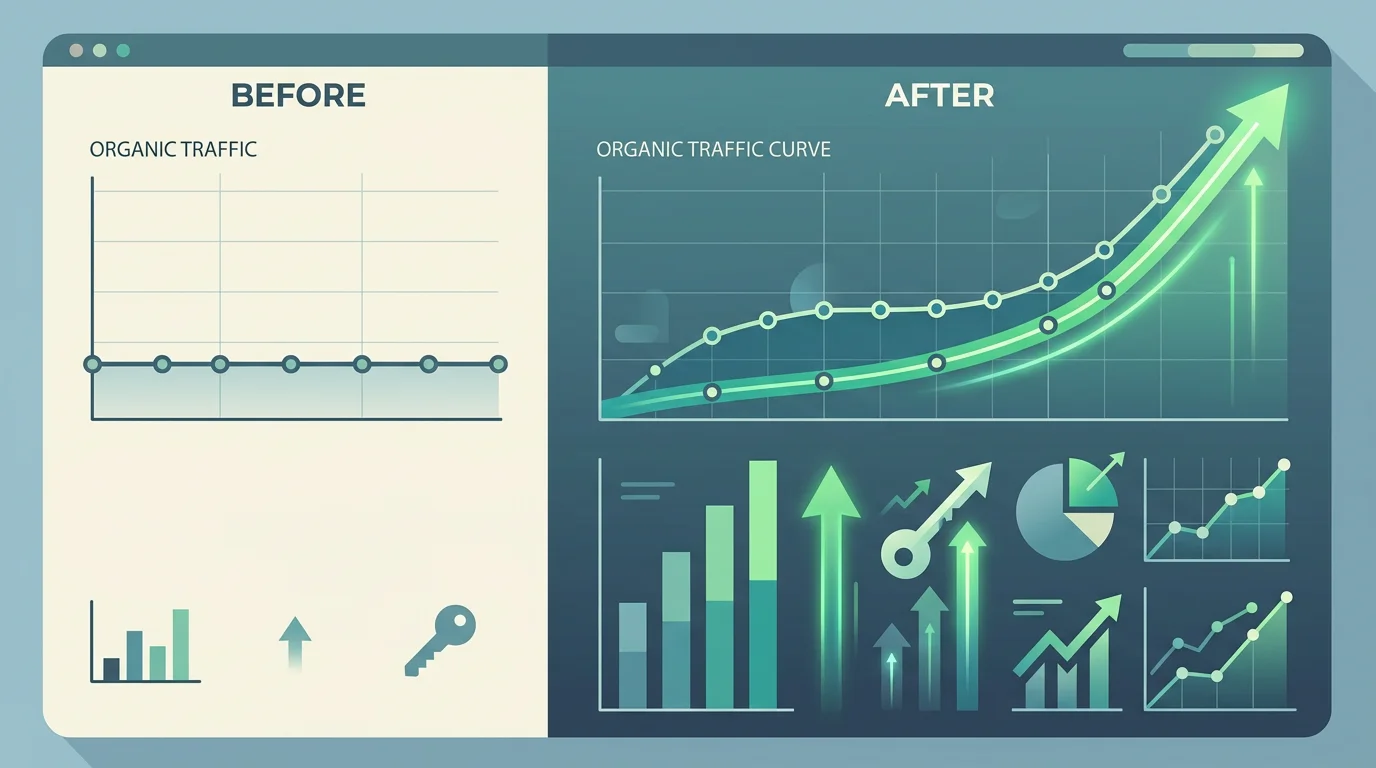
An accountancy firm in Nantes invested €1,200 in optimising 15 pages: titles, meta descriptions, heading structure, sector-specific examples and FAQs.
Within three months, organic traffic had risen by 41% and contact enquiries by 28%.
The cost of acquiring a lead fell from €87 through Google Ads to €23 through organic search. The investment paid for itself within four to six months.
On-page SEO is the most accessible search lever for an SME: no advertising budget and no link buying required.
Start with Google Search Console. Find the five pages with the most impressions and a CTR below 8%, then rewrite their titles and meta descriptions this week.
This step alone produces visible gains in three to six weeks.
We support French SMEs through this process, including consultancies, online retailers and vocational education providers. Our page on SEO in 2026 explains the next step.
It begins with an audit of priority pages, followed by focused optimisation of the 20% of pages holding 80% of the potential. To take this further, read Local SEO.
To get started, see our website redesign agency page. Improving the conversion rate is the next step once your rankings are stable.
SEO audits, content strategy and technical optimisation to help you climb Google.
Keep exploring
A project in mind?
Start with a free audit grounded in your goals, website and data.
Discutons de votre projet
30 min · Google Meet
Choisissez le créneau qui vous convient dans notre calendrier. On analyse votre situation avant l’appel pour aller droit au but.
Finding available times...