Refonte

La Refonte insights
UX design puts users at the heart of every design decision. Explore the process, tools and measurable business impact for SMEs.

Refonte
Design
SEO
Judge a UX redesign on three pillars: utility, usability and emotion. It should help visitors complete their goal, remove friction from the journey and create a coherent perception of the brand. No universal ratio can guarantee its return on investment: measurement must start with your own baseline and compare the same indicators after the redesign.
UX design (User Experience Design) is the discipline of designing digital products and services around users' needs, expectations and behaviour. Its purpose is to create interfaces that are useful, usable and enjoyable.
Econsultancy reports that 88% of surveyed online customers would be less likely to return after a poor experience. Published in 2021, this finding is not a universal rate for every website. It does, however, illustrate why UX design has become a performance lever for businesses with an online presence. Many SMEs still confuse UX design with aesthetics. User experience goes far beyond colours and typography: it includes information architecture, navigation journeys, loading speed and a website's ability to meet visitors' real expectations. This guide explains what UX design is, how it works and how to measure its effect on your website.
5 stages
in the UX process presented in this guide
88%
of surveyed customers would be less likely to return after a poor experience (Econsultancy, 2021)
€40,955
estimated average total pay for a UX/UI designer in France (Glassdoor, January 2026)
44.8k
clicks documented over twelve months in the CyclingCeramic case study
UX design covers all the methods and practices used to optimise a person's overall experience of a digital product, website, mobile app, software package or connected device. UX stands for User Experience. The discipline is not confined to digital products: it applies to any product or service with which a person interacts (source: Nielsen Norman Group, 2023).
Its fundamental principle is user-centred design (UCD). Instead of shaping a product around the internal preferences of the team, a UX designer starts with the real needs of its end users. They observe, interview, test and iterate. Design decisions are grounded in evidence rather than intuition. This approach reduces friction, raises satisfaction and maximises conversion.
UX design draws on several complementary fields: ergonomics, cognitive psychology, information architecture, web interface design and user research. A UX designer does not merely draw screens. They map journeys, identify pain points and propose solutions that align business objectives with the expectations of the target audience. For an SME, that means creating a website where each click takes the visitor closer to the intended action: requesting a quote, buying or getting in touch.
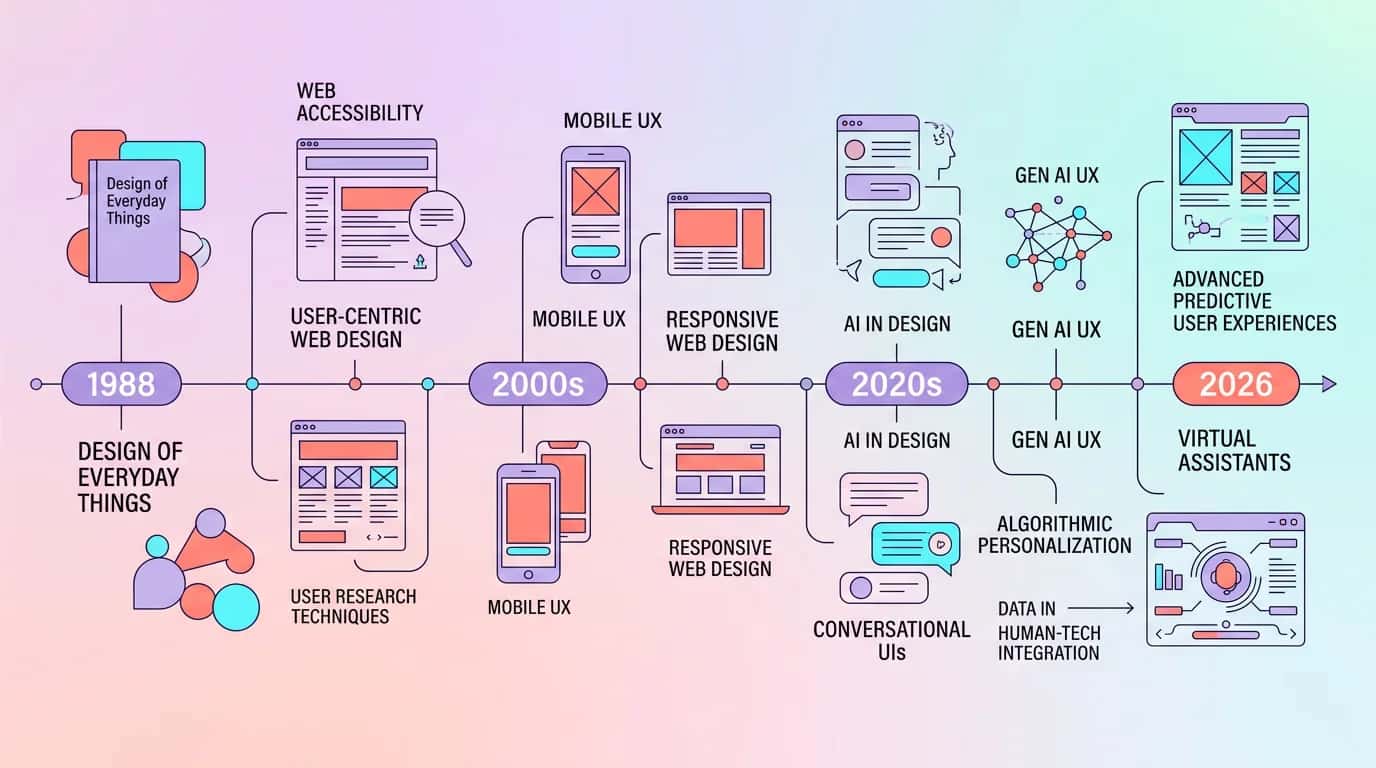
Donald Norman coined the term User Experience in 1993 while serving as Vice President of Apple's Advanced Technology Group. Norman wanted language that went beyond usability to encompass a person's entire experience of a system. His book The Design of Everyday Things (1988) had already laid the foundations of human-centred design (source: Don Norman, 1988).
UX design has deeper roots. In the 1940s, Toyota developed its production system with the human worker at the centre of the industrial process. During the 1970s, research into cognitive ergonomics and human–computer interaction (HCI) formalised the first methods for evaluating usability. Xerox PARC, followed by Apple, brought these principles into consumer computing (source: Interaction Design Foundation, 2024).
The spread of the web in the 2000s accelerated the adoption of UX design. Ecommerce businesses quickly learnt that a confusing interface cost them sales. Amazon pioneered the now-famous practice of continually A/B testing each interface element. Since 2015, UX design has matured into a profession in its own right, with recognised qualifications such as the Google UX Design Certificate and GOBELINS certification, and an established place in product teams at organisations of every size.
Confusing UX design with UI design is one of the most common mistakes in digital work. UX (User Experience) describes the user's overall experience: their journey, emotions and ease of completing a task. UI (User Interface) describes the visual interface: colours, typefaces, buttons, icons and layout. UX provides the structure; UI is the visible layer (source: Nielsen Norman Group, 2023).
Consider a restaurant. UX is the whole experience: the wait, the clarity of the menu, the flow of service and the comfort of the chair. UI is the interior presentation: the colour of the walls, the plating and the typeface on the menu. A beautiful restaurant with chaotic service delivers poor UX despite its strong UI. Conversely, an understated but perfectly organised venue can provide an excellent experience.
The distinction is the same on a website. The UX designer defines the website structure, wireframes, navigation flows and user tests. The UI designer applies a visual language to those structures, creating an attractive interface that is consistent with the brand identity. The two disciplines are complementary: a strong UX/UI partnership aligns form and function to maximise both user satisfaction and conversion.
| 01Criterion | 02UX Design | 03UI Design |
|---|---|---|
| 01Focus | The user's overall experience | The interface's visual appearance |
| 02Key question | Is the journey smooth and logical? | Is the interface attractive and consistent? |
| 03Tools | Personas, wireframes, user tests, journeys | Figma, colours, typography, grids |
| 04Main deliverable | Wireframes, user flows, test reports | High-fidelity mock-ups, design system |
| 05Measure of success | Completion rate, satisfaction (SUS score) | Visual consistency, adherence to brand guidelines |
| 06When it happens | Upstream: research and design | Downstream: applying a visual language to wireframes |
Focus
Key question
Tools
Main deliverable
Measure of success
When it happens
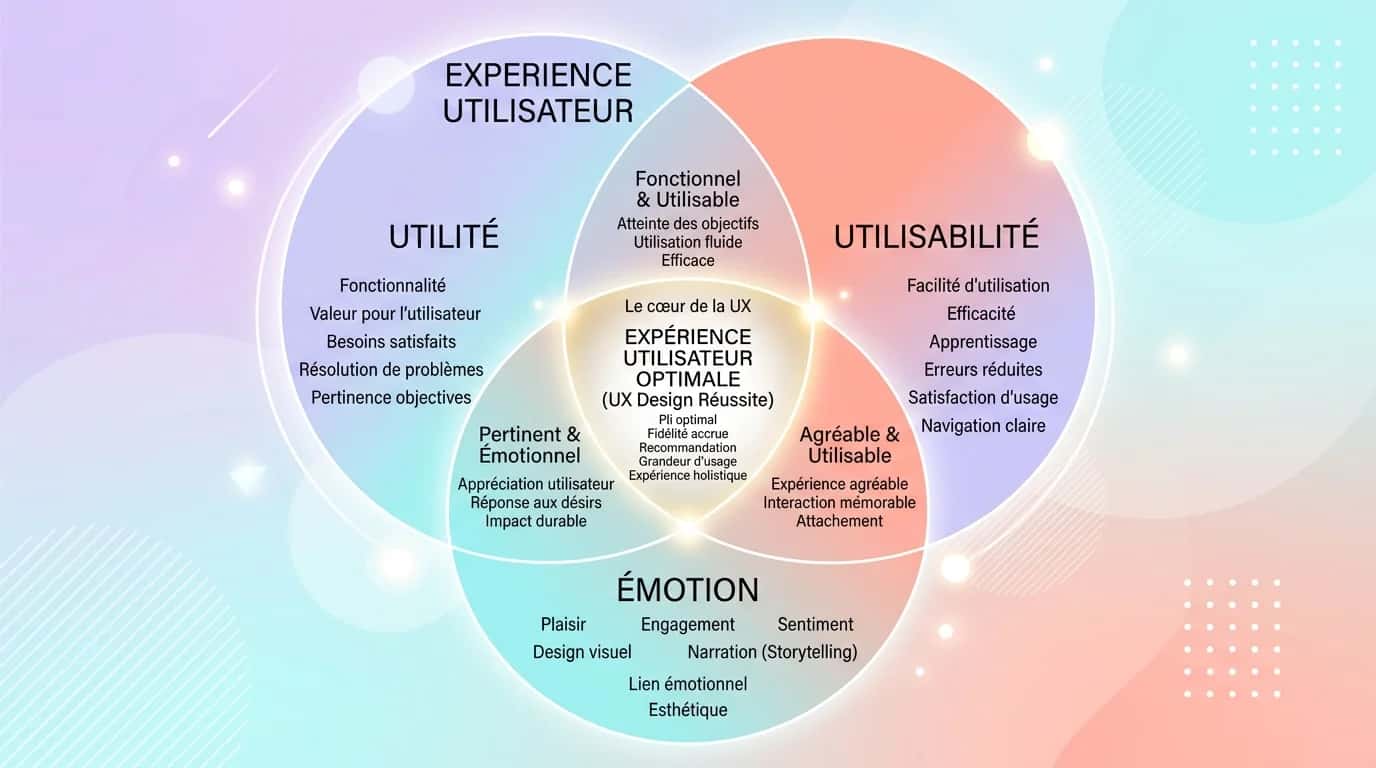
UX design rests on three fundamental pillars that guide every design decision: utility, usability and emotion. Developed in the work of researchers including Marc Hassenzahl and Donald Norman, these three dimensions underpin every successful user experience. Neglecting any one of them undermines the entire approach (source: Hassenzahl, 2010).
Utility asks whether the product solves a real problem. A brochure website that fails to present its services, prices or contact details clearly falls at this first hurdle. Utility is validated through user research: interviews, surveys and behavioural data analysis. 67% of consumers cite relevant content as their leading measure of website quality (source: HubSpot, 2024). For an SME, this means every page should answer a specific visitor intent.
Usability measures how easily users complete their tasks. A contact button hidden at the bottom of a page, a 15-field form or a navigation menu with 12 entries all create obstacles that increase bounce rate. ISO 9241-210 defines usability through three criteria: effectiveness, efficiency and satisfaction. Steve Krug captured the idea in the celebrated phrase Don't Make Me Think.
Emotion is the third pillar, and one SMEs often overlook. A website can be useful and usable yet still feel bland. Emotional design—micro-interactions, subtle animation and an appropriate tone of voice—turns a functional visit into a memorable experience. Donald Norman identifies three levels of emotional processing: visceral (first impression), behavioural (ease of use) and reflective (memory and brand perception). A site that addresses all three builds greater trust and loyalty.
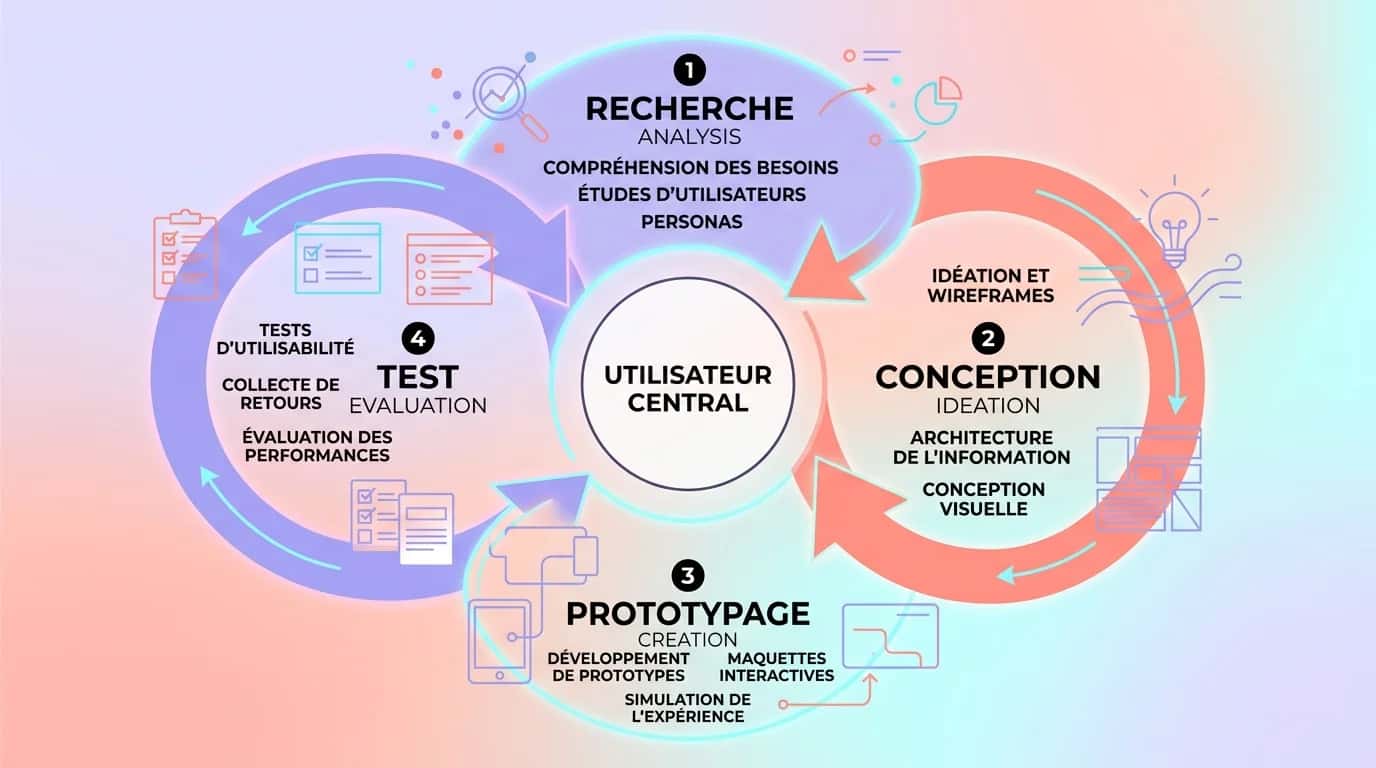
UX design is not a one-off activity but an iterative process organised into phases. Each stage produces tangible deliverables that inform the next. Inspired by the Design Thinking approach popularised by Stanford University, the process can be adapted to every budget, including those of SMEs. The key is never to skip research, even when time is tight. Just five participants identify 85% of usability problems (source: Nielsen Norman Group, 2000).
Étape 1
Gather evidence from real users through one-to-one interviews, online surveys, Google Analytics data and card-sorting exercises. The aim is to understand who your visitors are, what they seek and which obstacles they encounter. For an SME, five to eight 30-minute interviews are enough to reveal the main points of friction.
Étape 2
Turn your research into personas: fictional profiles representing your key user segments. Each persona has a name, context, goals and frustrations. Then map the user journey: the steps that persona follows to achieve their main objective on your website. This map reveals the critical moments at which the experience can break down.
Étape 3
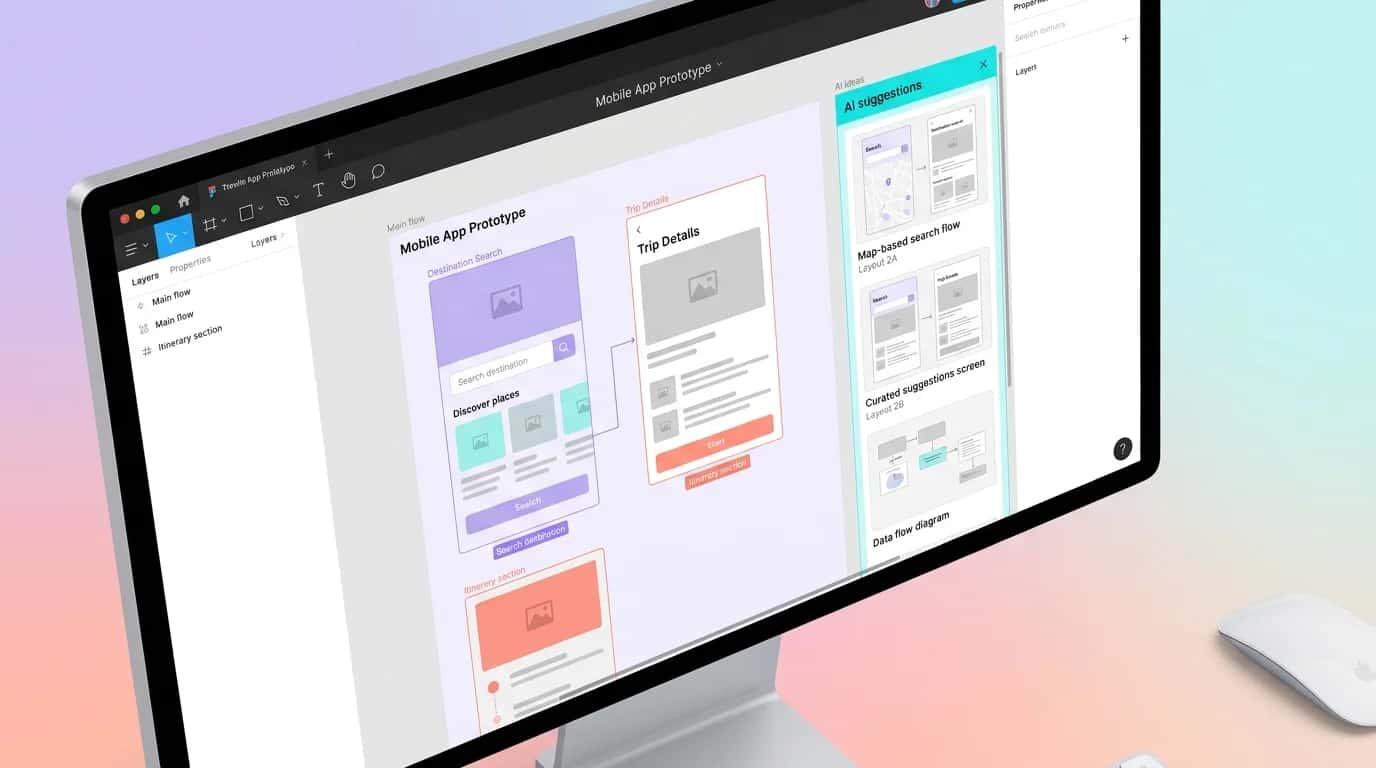
Translate journeys into wireframes—the visual skeletons of your pages. Do not add final colours or imagery: focus on structure, information hierarchy and interaction areas. Figma, Balsamiq or even paper can produce wireframes quickly. This stage validates the information architecture before money is committed to visual design.
Étape 4
Turn wireframes into clickable prototypes that simulate the real experience. Figma and Adobe XD can create high-fidelity prototypes within a few hours. The prototype is the central communication tool linking UX designer, client and developers. It lets the team test the experience before writing a single line of code.
Étape 5
Ask real users to complete specific tasks using your prototype. Observe their reactions, hesitations and mistakes. Testing reveals problems that the project team cannot see. Correct, retest and improve. This cycle continues after launch: UX design never truly stops.
Design Thinking is a broad innovation method that can be applied to any problem, product, service or organisational process. UX design is a specific application of Design Thinking to digital interfaces. Both share the same principles: empathy, ideation, prototyping and testing. Their scope differs: Design Thinking can reshape an entire business model, whereas UX design focuses on the experience of a digital product (source: IDEO, 2023).
For an SME redesigning its website, UX design is enough. Design Thinking becomes relevant when the offer itself is in question: should the business build a brochure website, an ecommerce store or an app? This strategic framing comes before the UX work itself. The approaches complement rather than replace one another. Our page on Ecommerce Website Redesign explains the next step.
A UX designer is a multidisciplinary professional combining analytical, creative and interpersonal skills. Their central role is to understand users and translate their needs into design solutions. They work early in a project, collaborate with developers, project managers and marketing teams, and validate their choices through testing (source: Glassdoor, 2025).
Technical skills include proficiency with prototyping tools such as Figma, Sketch and Adobe XD; user-research methods such as interviews, usability tests and eye tracking; information architecture; and UX writing. A working knowledge of responsive design and web accessibility is also expected. A good UX designer can read basic HTML and CSS without necessarily being a developer.
Human qualities matter just as much. Empathy—the ability to take the user's perspective without projecting personal preferences—is paramount. Curiosity, critical thinking, synthesis and confident communication follow closely. UX designers spend much of their time presenting and defending recommendations to stakeholders. The ability to argue from evidence rather than opinion distinguishes a senior practitioner from a junior one.
Available figures vary with the exact job title, location and level of experience. Glassdoor estimated average total pay for a UX/UI designer in France at €40,955 a year in January 2026. Its most likely range, from the 25th to the 75th percentile, was €34,738 to €46,775.
Glassdoor's observed range was €31,219 to €55,044. The figures are based on 517 anonymously submitted salaries. They offer a market reference, not a contractual salary scale by experience. When comparing an offer, consider the scope of the role, the share of user research, product responsibilities and location.
The Robert Half 2026 Salary Guide confirms that specialisation and proficiency with digital tools widen pay differences at equivalent levels of responsibility. Its accessible French page does not provide a level-by-level table for UX designers alone. The table below therefore uses only verifiable Glassdoor data. To take this further, read Landing Pages.
| 01Glassdoor reference | 02Annual amount | 03Meaning |
|---|---|---|
| 0125th to 75th percentile | EUR 34,738–46,775 | Most likely range |
| 02Estimated average | EUR 40,955 | Annual total pay |
| 03Observed range | EUR 31,219–55,044 | Variation by experience and context |
25th to 75th percentile
Estimated average
Observed range
A UX redesign can change conversion, understanding of an offer or the volume of support requests. There is, however, no universal ratio that applies to every business. Measurement must begin with your own journeys and a documented baseline.
For an SME, track whether visitors can complete a priority task, such as submitting a form. Then measure conversions linked to that task and support requests caused by an unclear interface. Compare the same indicators across two coherent periods.
A simplified journey or better-placed CTA has value only when the evidence confirms its effect. This measurement belongs to a UX redesign method that sets the baseline before the first mockup. The CyclingCeramic case study provides a contextualised redesign example with Search Console measurements. It does not isolate UX ROI or promise the same result. This method links improved conversion rates to traceable observations.
CyclingCeramic sells technical cycling components to an international audience. Its redesign addressed catalogue clarity, journeys between guides and products, and mobile adaptation. The design choices aimed to make technical detail useful rather than intimidating.
For the twelve-month window ending on 4 August 2026, Search Console recorded 44.8k clicks and 1.63 million impressions. Mobile accounted for 25,451 clicks, compared with 18,445 on desktop. These figures show why the mobile journey and content hierarchy matter during a redesign. They cannot attribute every click to design alone.
The CyclingCeramic SEO and GEO case study publishes the source captures, queries and pages involved. The Vintage Bike Shop case study offers another example involving a specialist catalogue and editorial journey. The evidence remains properly contextualised rather than turning correlation into a commercial promise.
There is no single route into UX design. The field attracts graphic designers, developers, ergonomists, psychologists and project managers. Structured study can speed up skill development, but the format should suit the objective: establishing shared knowledge within a team, building a professional specialism or changing careers entirely. Practical work should include learning how to turn an intention into a website mock-up.
Several French schools offer degree-level programmes, including GOBELINS, L'École de Design Nantes Atlantique, Sup de Pub and ECV, with varying levels of specialisation. Intensive programmes from providers such as Ironhack and Le Wagon cover the fundamentals of product design and prototyping.
Online qualifications are another option. The Google UX Design Professional Certificate introduces the full UX process. Nielsen Norman Group certification is aimed at professionals wishing to deepen a specific method. Always compare the time commitment, practical work and human support before deciding.
Artificial intelligence is changing UX design practice at unprecedented speed. Design tools now include AI features such as automated wireframe generation, component suggestions and predictive analysis of user journeys. Figma has launched AI-powered auto layout, Adobe offers Firefly for generating visual assets, and tools such as Galileo AI produce complete mock-ups from a written brief (source: Gartner, 2025).
For UX designers, AI is an accelerator, not a replacement. Repetitive tasks such as producing variants, resizing and documentation can be automated. Designers can focus on what AI cannot do: understand human context, balance conflicting needs and make ethical decisions. User research, the core of UX, remains fundamentally human. No AI can replace an empathetic interview with a real user.
The central challenge for 2026 is the UX of AI itself. How can designers build interfaces that use AI transparently without creating mistrust? Chatbots, personalised recommendations and adaptive interfaces raise questions of ethics and confidence. Tomorrow's UX designer must understand explainable AI and ethical design to create experiences that inspire trust rather than suspicion. SMEs incorporating AI into their products need this expertise to avoid personalisation that feels intrusive.
UX design is a culture of continuous improvement. For an SME, that does not necessarily mean hiring a full-time employee. It means testing before development, measuring after every change and listening to users. A UX consultant can also pass the method on to the team that will operate the website.
Begin by auditing the current site. Use analytics data to identify abandonment points. Install a heatmapping tool if your consent framework allows it. Then ask five people to complete a task without guidance. This is the logic of Lean UX: observe, form a hypothesis, test and learn.
Prioritise fixes according to their effect on the user's task. A clear form may be more valuable than a complete visual redesign. Before publishing, remember to check the mobile display before launch at several sizes and on a real device.
Finally, define simple indicators: completion rate, conversion, errors encountered and SUS score. Measure them before and after the change. You can then distinguish a cosmetic change from a genuinely useful improvement.
| 01Criterion | 02Build in-house skills | 03Use tools independently | 04Delegate |
|---|---|---|---|
| 01Time required | Time for study and internal practice | Time to learn the tools and analyse results regularly | Time for scoping and approval |
| 02Autonomy gained | A reusable method for the team | Autonomy over measurement and straightforward tests | Actionable recommendations for the team or agency |
| 03Support | Independent study and practical exercises | Figma, analytics tools and user testing | Website audit and design |
Time required
Autonomy gained
Support
UX encompasses every aspect of the end user's interaction with a company, its services and its products. The first requirement for an exemplary user experience is to meet the customer's exact needs without friction or fuss.
Our UX/UI designers audit your website, identify friction and design an interface that converts. A free UX audit is included for SMEs.
UX design is no longer reserved for large technology companies. The tools have become widely accessible, skills can be developed through many routes, and ROI can be measured from the first few weeks. Whether you are launching a new website or improving an existing one, putting users at the centre of design decisions is the most reliable way to improve digital performance. SMEs that make UX part of their strategy do more than build an attractive website: they create a durable competitive advantage founded on customer satisfaction.
Last updated: August 2026
Keep exploring

A project in mind?
Start with a free audit grounded in your goals, website and data.
Discutons de votre projet
30 min · Google Meet
Choisissez le créneau qui vous convient dans notre calendrier. On analyse votre situation avant l’appel pour aller droit au but.
Finding available times...