Refonte

La Refonte insights
Compare the seven best AI assistants in 2026, with an integration guide, selection criteria and measured ROI from real SME examples.

Refonte
SEO

IA
An AI assistant is artificial-intelligence software that understands natural language and performs automated tasks—writing, data analysis, research and planning—to multiply day-to-day productivity without requiring technical skills.
67% of organisations worldwide use at least one AI tool in their operations (source: McKinsey, 2024). This rapid adoption now extends to French SMEs: an AI assistant can draft emails, summarise meetings, analyse spreadsheets and answer customers around the clock. The global artificial-intelligence market reached $184 billion in 2024 (source: Statista, 2024), driven by growing demand for accessible tools.
A conventional chatbot follows predefined scripts. An AI assistant understands context, learns from your habits and improves with each interaction. The generative AI behind these tools—GPT-4o, Gemini and Claude—allows them to produce text, images and code at near-human quality. AI assistants, generative AI and AI agents differ in their level of autonomy: the assistant responds to requests, generative AI creates content, and an agent carries out sequences of tasks autonomously.
AI assistants in figures
67%
of businesses use AI (McKinsey, 2024)
+40%
average productivity per user (Accenture, 2024)
$184bn
global AI market in 2024 (Statista)
3 hrs/day
saved on average by each employee (HubSpot, 2024)
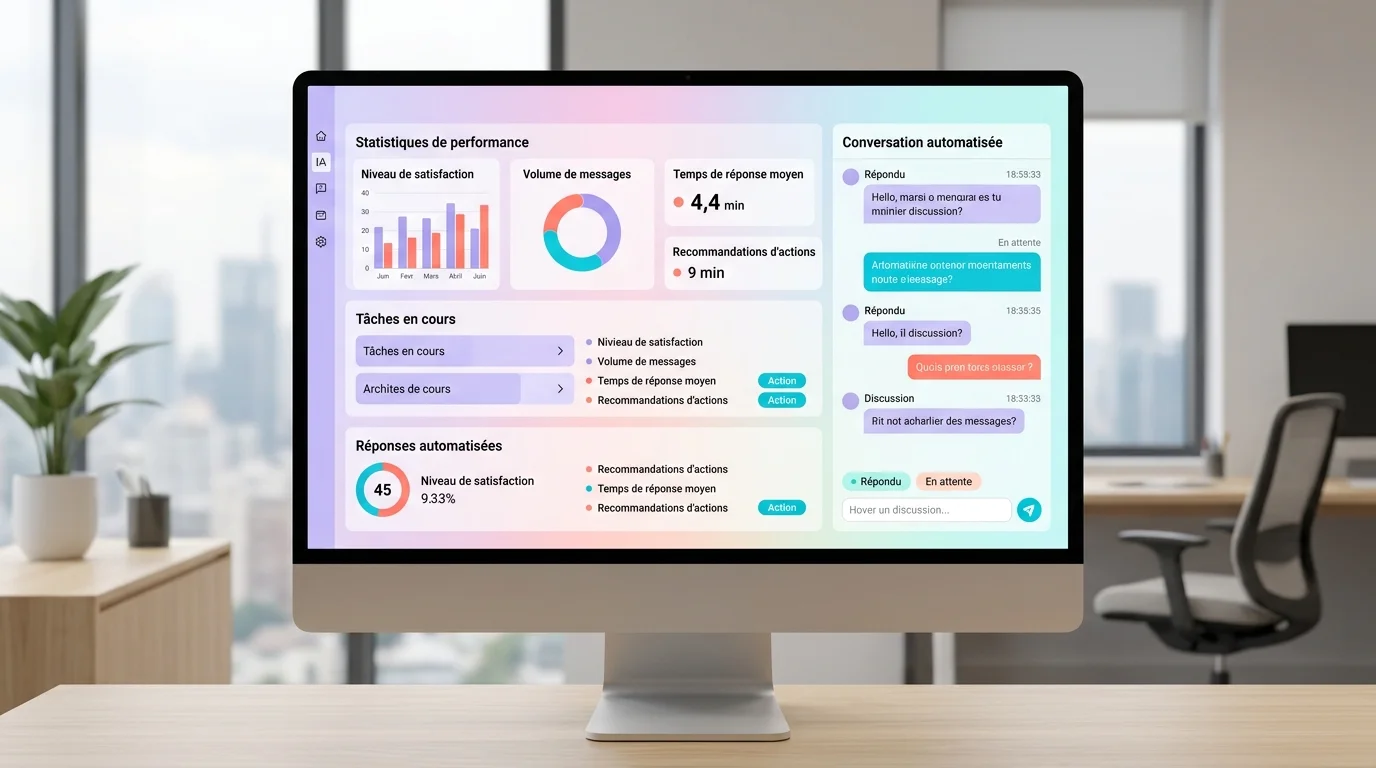
The right AI assistant depends on your technical ecosystem, budget and priority use cases. This comparison covers seven leading tools, assessed on real SME tasks: writing, data analysis, research and repetitive-task automation. Prices shown are those listed in March 2026.
| 01Tool | 02Provider | 03Free plan | 04Pro price/month | 05Main strength |
|---|---|---|---|---|
| 01ChatGPT | OpenAI | Yes | $20/month | Versatility (text + code + images + plug-ins) |
| 02Gemini | Yes | $21.99/month | Native Google Workspace integration | |
| 03Microsoft Copilot | Microsoft | Yes | $30/month | Excel, PowerPoint and Outlook automation |
| 04Claude | Anthropic | Yes | $20/month | Long-document analysis (200k tokens) |
| 05Mistral Le Chat | Mistral AI | Yes | Free | Data sovereignty (servers in France) |
| 06Perplexity | Perplexity AI | Yes | $20/month | Web research with verifiable sources |
| 07Notion AI | Notion | No | $10/month | Project management and knowledge base |
ChatGPT
Gemini
Microsoft Copilot
Claude
Mistral Le Chat
Perplexity
Notion AI
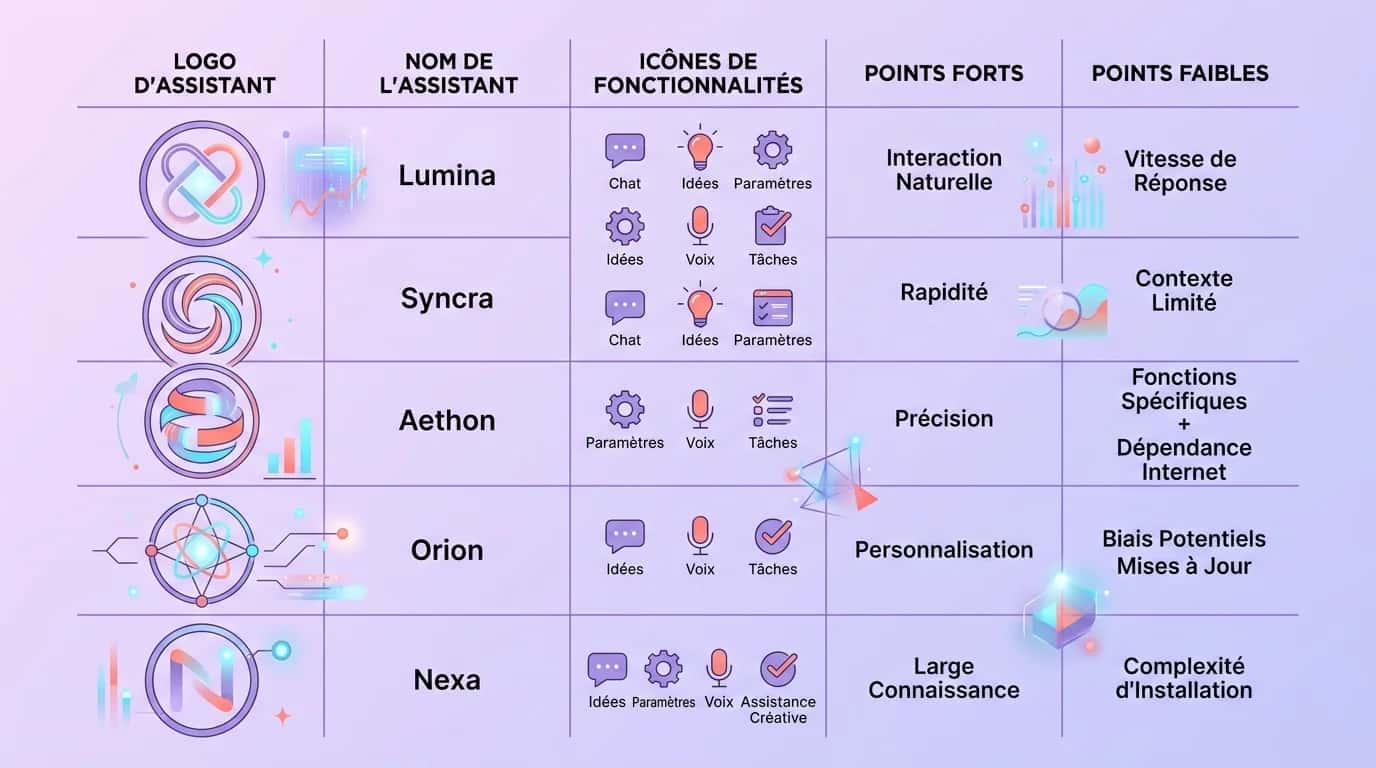
Criterion 1: integration with your existing tools. If your team works in Google Workspace, Gemini is a natural fit. In Microsoft 365, Copilot automates Excel, PowerPoint and Outlook without leaving the interface. An AI assistant integrated into your ecosystem cuts adoption time by 60% compared with a standalone tool (source: Forrester, 2024). Check available connectors before committing to a subscription.
Criterion 2: data privacy and location. Server location is decisive for SMEs handling sensitive health, financial or legal data. Mistral Le Chat hosts its data exclusively in France, an advantage in meeting GDPR requirements. DINUM's Albert initiative shows that even the public sector demands this sovereignty for its staff (source: Alliance Numérique, 2026). OpenAI and Anthropic guarantee that they do not use business-account data to improve their models.
Criterion 3: cost versus impact on your use cases. A free assistant is enough for occasional writing. For automation at scale, including industrial automation of business processes, Pro versions can justify the investment. Calculate 90-day ROI as (hours saved × hourly cost) minus monthly subscription. An SME with ten employees paid €25 an hour that saves two hours a day per person saves €10,000 a month for a tool cost of €200–€300.
Emails, reports, marketing content and customer replies produced within seconds from a brief or template
Excel spreadsheets, financial PDFs and databases interpreted with actionable summaries and charts
Sourced answers drawn from the web or internal documents, with verifiable citations
Repetitive tasks triggered by rules, voice commands or calendar events
Images, presentations, charts and videos created from straightforward written descriptions
Translation across more than 100 languages, adapting tone, register and cultural references
Adopting an AI assistant involves more than creating an account and hoping for results. Without a structured method, teams abandon the tool within a month: 54% of AI projects fail because the initial framing is inadequate (source: Gartner, 2024). Tested with our SME clients, this five-stage process supports lasting adoption and measurable returns within the first quarter. In human resources, a specialist HR chatbot handles 70% of recurring enquiries without human involvement.
Étape 1
Identify the ten most time-consuming tasks in each department. Prioritise structured, predictable work such as data entry, standard email replies, weekly report generation and customer follow-ups.
Étape 2
Compare the table above with your current technology stack. Test two or three tools on a free plan for two weeks using one specific use case. Measure response quality and time saved.
Étape 3
Deploy the assistant in one department for 30 days. Measure three indicators: time saved per employee, error rates before and after adoption, and user satisfaction through a short questionnaire.
Étape 4
Create a library of prompts tailored to your activity. A well-structured prompt triples response quality (source: HubSpot, 2024). Share the strongest prompts in a common document accessible to everyone.
Étape 5
After 90 days, calculate the real return on investment: time saved × hourly cost − subscription. Roll out to the remaining departments, adjusting prompts and workflows in response to practical feedback.
Marketing promises are no substitute for real-world evidence. These two SMEs, supported by our team, illustrate the measurable effect of an artificial-intelligence assistant introduced methodically. The results cover the first 90 days after deployment.
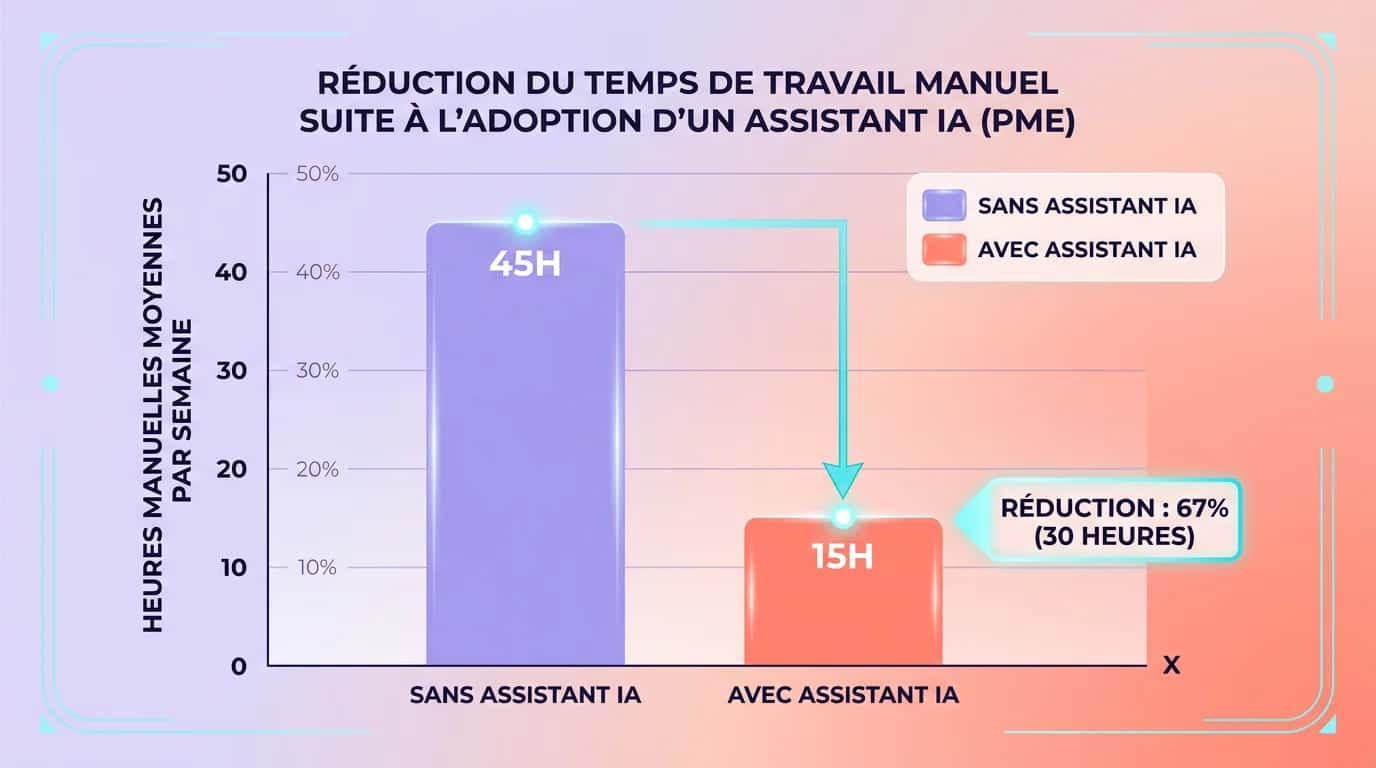
“We introduced an AI assistant to process our orders and answer frequently asked questions. Time spent on emails fell from three hours to 45 minutes a day. Our eight employees can now focus on customer advice and business development.”
Data privacy remains the leading objection among SME directors. Do financial documents, contracts and customer data pass through third-party servers? The answer depends on the chosen tool and configuration. Cloud models—ChatGPT, Gemini and Claude—process data on remote servers. OpenAI and Anthropic contractually guarantee that they do not use Team and Enterprise account data to improve their models (source: OpenAI, 2024).
For highly sensitive data, Mistral Le Chat offers exclusively French hosting with HDS certification for the health sector. The on-premises alternative is gaining ground: Lenovo Qira, announced in early 2026, processes all data locally on the device and synchronises across devices without using the cloud (source: Science et Vie, 2026). DINUM's Albert initiative shows that the French public sector requires this degree of sovereignty for its 10,000 staff testers (source: Alliance Numérique, 2026).
The GDPR imposes specific obligations when using an AI assistant: a processing register, a data protection impact assessment (DPIA) for sensitive data and the right to erase conversations. Check that your tool offers data export and deletion on request. Every tool compared above does so on its professional plans.
The AI assistant of 2026 does more than answer questions: it acts. Autonomous AI agents are the next major development, performing complex task sequences without human intervention. They can book a flight, compare suppliers, draft and send a quotation from a single instruction. Gartner predicts that 25% of workplace interactions will involve an autonomous AI agent by the end of 2026 (source: Gartner, 2025).
Google and Microsoft are already incorporating agentic capabilities into Gemini and Copilot. Personalisation is accelerating: assistants remember preferences, writing style and business processes to supply well-calibrated answers from the outset. Multimodal models handle text, images, video and audio simultaneously, allowing a single assistant gradually to replace several specialist tools. Our page on SEO and GEO explains the next step.
For SMEs, this convergence means less manual configuration and faster ROI. Access costs continue to fall: Mistral Le Chat is free, while leading Pro plans have remained at about $20 a month since 2024. The question for your business is no longer whether to adopt an AI assistant, but which one will best support its growth and changing needs.
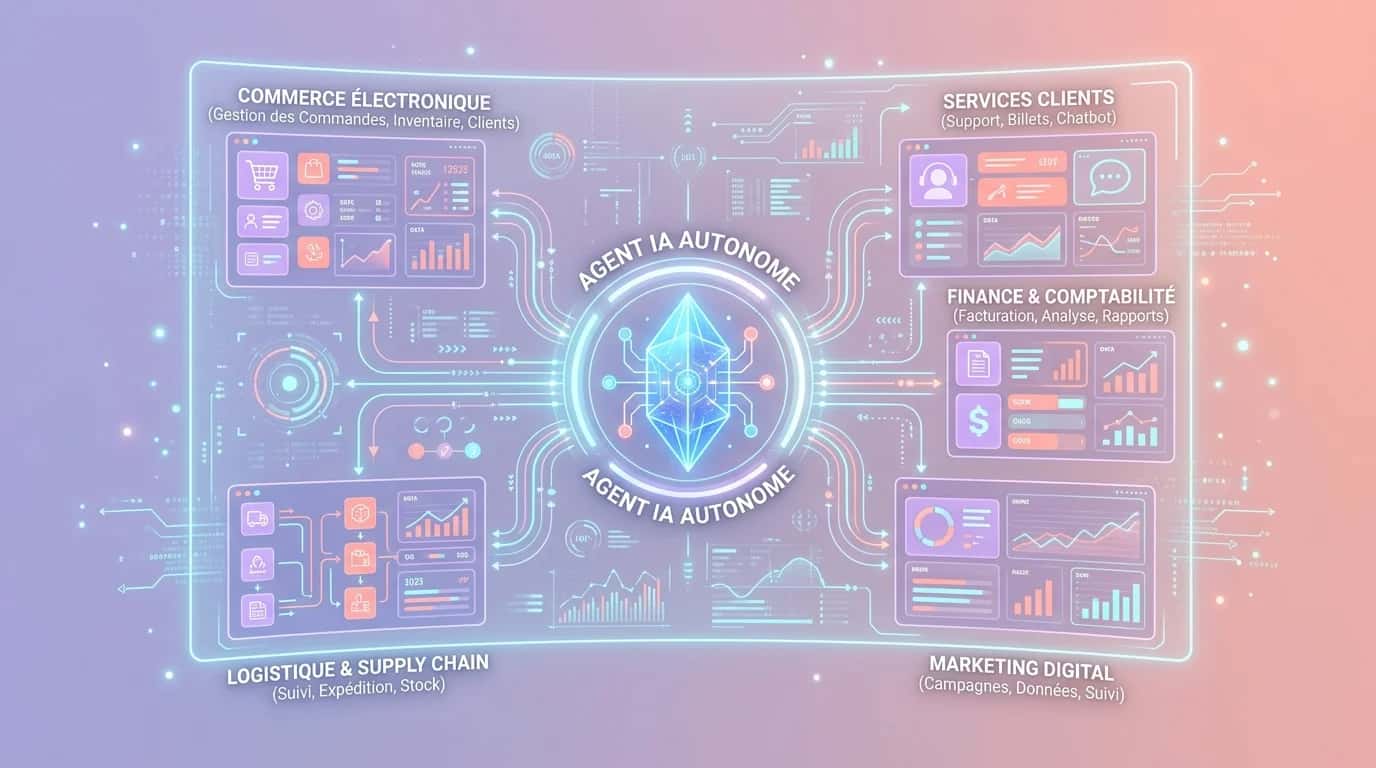
Our team helps you select, deploy and optimise your AI assistant, from the initial audit through to measuring results over 90 days.
Last updated: March 2026
A project in mind?
Start with a free audit grounded in your goals, website and data.
Discutons de votre projet
30 min · Google Meet
Choisissez le créneau qui vous convient dans notre calendrier. On analyse votre situation avant l’appel pour aller droit au but.
Finding available times...


How an AI assistant works: NLP, learning and memory
Three core technologies power every AI assistant. Natural language processing (NLP) decodes requests written in everyday language. Write ‘summarise this 50-page report in five points’ and the tool identifies the intention, expected format and level of detail. Models available in 2026 can handle contexts of 128,000 to two million tokens (source: Google, 2025), equivalent to several books in one conversation.
Machine learning refines responses through your interactions. The more you use the assistant, the better it adapts suggestions to your sector's vocabulary and your preferences. Some tools, such as Lenovo Qira, process data locally on the device (source: Science et Vie, 2026), without sending information to a remote cloud—an important privacy benefit.
Contextual memory distinguishes modern AI assistants from earlier tools. ChatGPT, Claude and Gemini retain recurring instructions, writing style and business processes from one session to the next. This progressive personalisation reduces configuration time by 60% after the first month of use (source: Forrester, 2024).