

SEO

La Refonte insights
Audit, SEO migration, content, testing and monitoring: the workstreams to compare when budgeting a professional website redesign in 2026.
SEO

Refonte

IA
A professional website redesign budget combines the existing-site audit, scoping, design, technical migration, content, testing and post-launch monitoring. The price changes with page volume, functionality and the extent of the SEO migration. Request a quote split by workstream and calculate total cost of ownership, including maintenance and licences.
Three quotes. Three completely different prices: €1,800, €8,500 and €22,000 for the same brief. That was the experience of a small construction company that contacted us after spending two months trying to understand such a wide gap. They were not necessarily looking for the cheapest option. They wanted to understand what they were buying.
Web design is one of the least transparent markets around. Prices vary enormously, sometimes for reasons that have little to do with quality or the true complexity of a project. A €1,500 website may be exactly right for your circumstances. A €30,000 website may become an expensive disappointment. The difference often comes down to knowing which questions to ask.
This guide explains the factors that genuinely affect price, gives realistic ranges for different types of website and provider, and helps you avoid common traps. That includes the lowest quote, which is often the most expensive option in the long run. If you already have a website and are considering an update, our guide to website redesign costs covers a different but complementary scope. For a more focused project, our guide to brochure websites for small businesses explains how to define the brief and choose a platform.

When one quote is five times the price of another for the same brief, dishonesty is rarely the main reason. More often, the providers have interpreted your needs differently, and the brief itself may not yet be clear enough.
The first and most significant factor is functional complexity. A five-page brochure website with a contact form is technically straightforward. A website with a customer portal, online booking, CRM synchronisation and integrated payments is a very different undertaking, even if the end result looks similar. Every bespoke feature adds development time.
Then there is design. Adapting a €60 WordPress theme is one thing. Developing an original visual identity, bespoke page designs and micro-interactions is another. The budget can differ by a factor of five. Reputable agencies include a design phase with several rounds of feedback. That iteration has a cost, but it is justified when your brand is a strategic asset.
Content is consistently underestimated. Who writes the copy? Who supplies the photography? Who produces the videos? If you do it yourself, the project may slow down and the result is often less polished. If the provider handles it, content becomes a substantial budget item. Expect to pay between €80 and €200 for professionally written page copy, and several thousand euros for a properly executed product shoot.
Initial search engine optimisation is another variable. Some providers deliver a website with no SEO work at all. Others build in semantic structure, metadata, internal links and technical performance from the outset. The difference in results after 12 months can be considerable, but it is not always obvious from the initial quote.
Finally, your choice of content management system affects long-term costs. WordPress remains the most widely used and flexible option, but it requires regular maintenance. Webflow costs more to build in many cases, but tends to be more stable over time. A bespoke platform gives you complete freedom, at the cost of greater technical dependence on your provider. To take this further, read wordpress agency.
A redesign is not priced like an isolated new build. The provider must understand the existing website, decide what to retain, build the new version and organise the switch. Quotes become comparable when every phase produces an identifiable deliverable. For a practical continuation, see Website Under Maintenance.
Inventory pages, content, functionality, accounts, data, analytics and technical constraints. Identify pages already generating visits or enquiries. Scoping then defines objectives, users, structure, functionality, content ownership and acceptance criteria. To take this further, read User Research Consultant.
The technical migration covers the environment, CMS, components, forms, data and business integrations. Ask who owns backups, staging tests and rollback. SEO migration requires an old-to-new URL map, permanent redirects, internal links, canonicals, sitemaps and indexing checks. The SEO redesign scope should be a separate line in the quote.
Separate content retained, rewritten, created and integrated. Testing covers forms, journeys, browsers, mobile, agreed accessibility and external connections. After launch, compare indexing, errors, traffic and conversions against the retained baseline.
| 01Stage | 02Associated cost | 03What changes the price | 04Deliverable to request |
|---|---|---|---|
| 01Existing-site audit | Technical, editorial and data analysis | URL volume, integrations and available history | Prioritised inventory and baseline |
| 02Scoping and design | Discovery sessions, information architecture, UX and design | Journeys, templates and approval cycles | Scope, designs and acceptance criteria |
| 03Technical migration | Development, integration and data transfer | CMS, formats, functionality and business connections | Staging environment, backup and rollback plan |
| 04SEO migration | URL inventory, redirects and indexing checks | Page volume and architecture changes | Redirect map and crawl report |
| 05Content, testing and launch | Writing, integration, acceptance testing and deployment | New content, tested devices and journey complexity | Acceptance record and issue list |
| 06Post-launch measurement | Monitoring, corrections and indicator analysis | Monitoring window and correction commitments | Before-and-after table and stabilisation report |
Existing-site audit
Scoping and design
Technical migration
SEO migration
Content, testing and launch
Post-launch measurement
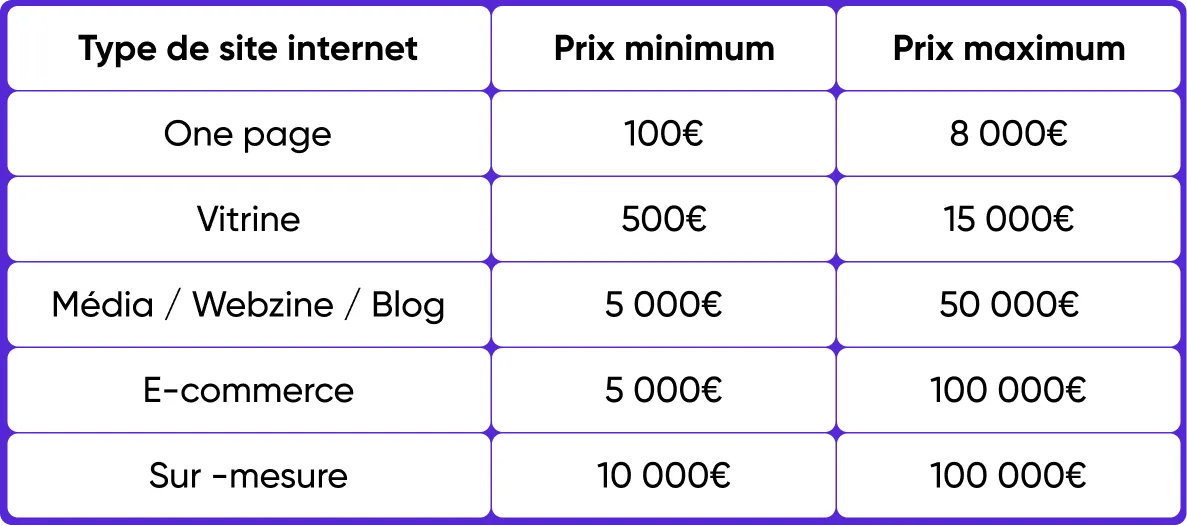
The ranges below frame an initial budget discussion. They do not replace the redesign workstreams above and exclude content and maintenance, as the table states. Our page on Website Maintenance explains the next step.
| 01Website type | 02Budget | 03Timescale | 04Best suited to |
|---|---|---|---|
| 01No-code website (Wix, Squarespace) | €0–€500/year | 1–2 weeks | Sole traders and quick market tests |
| 02Simple brochure website (template) | €1,500–€5,000 | 3–6 weeks | Microbusinesses, tradespeople and independent professionals |
| 03Advanced brochure website (bespoke) | €5,000–€15,000 | 6–12 weeks | SMEs for which brand image is a priority |
| 04Standard ecommerce website | €4,000–€15,000 | 8–16 weeks | Retailers with fewer than 500 products |
| 05Advanced ecommerce website | €15,000–€40,000 | 3–6 months | Large catalogues and complex logistics |
| 06Bespoke website or web application | €20,000–€80,000+ | 4–12 months | Specific workflows, B2B platforms and SaaS products |
No-code website (Wix, Squarespace)
Simple brochure website (template)
Advanced brochure website (bespoke)
Standard ecommerce website
Advanced ecommerce website
Bespoke website or web application
Choosing between a web agency, a freelancer and a no-code builder is not simply a budget decision. It is about risk, ongoing support and the skills you can draw on in-house.
No-code website builders such as Wix, Squarespace and Jimdo can get a website online quickly for a few hundred euros per year. They work well for testing an idea, maintaining a basic online presence or running a personal site. Their limitations soon become apparent, however: restricted customisation, often mediocre SEO performance and little scope for specific functionality. Most importantly, you own your content but rent the platform. If Wix changes its pricing or closes, you may have to start again.
A capable freelancer can deliver an excellent result for between €2,000 and €8,000. This is often the best value for a modest project. The drawback is your dependence on one person. If the freelancer becomes ill, changes career or simply disappears, your project is put on hold. That risk may be acceptable for a straightforward brochure website. For an ecommerce operation with thousands of products and significant commercial stakes, it is a genuine vulnerability.
A web agency offers structure, a multidisciplinary team spanning design, development, project management and SEO, and continuity of service. The starting price is higher, and rarely below €5,000 for a serious project, but the support, method and accountability can justify the difference when the website matters to the business. Some agencies, including La Refonte, specialise in particular types of project. That focus can lead to sharper execution in their chosen field.
Whatever type of provider you choose, always ask to see relevant examples of similar work. A portfolio full of corporate websites for large organisations tells you little about a provider's ability to build a high-performing ecommerce site for a small manufacturer.
A redesign quote often describes initial production without listing subscriptions, responsibilities and post-launch work. Request a total-cost-of-ownership appendix naming every recurring expense, account holder, renewal date and administrator.
A domain is a separate subscription. France Num gives a range of €5 to €50 before tax per year depending on the extension. On 24 August 2026, OVHcloud listed .fr at €4.99 before tax for the first year and €7.79 before tax on renewal. Check renewal rather than the promotion and keep the domain in the company's name.
France Num puts hosting at €5 to €500 before tax per month depending on the website, features and traffic. The quote should state resources, backups, support, security and the price after any promotional period.
Separate preventive, corrective and enhancement work. Ask about backup and update frequency, incident response, exclusions and included enhancement time. Our website maintenance guide lists the controls to specify.
Add plugins, email, payments, booking, consent and analytics to total cost of ownership. Name the product, plan, account holder, billing interval and cancellation process, including what happens if the provider no longer maintains the website.
| 01Item | 02Indicative cost | 03What to check |
|---|---|---|
| 01Domain name | .fr at OVHcloud: €4.99 before tax in year one, €7.79 before tax on renewal | Renewal price and domain holder |
| 02Hosting | €5–€500 before tax per month according to France Num | Backups, security, support and resources |
| 03Maintenance | Monthly retainer or ad hoc work | Preventive, corrective and enhancement work |
| 04Tools and licences | Free, subscription-based or commission-based | Account ownership, usage limits and cancellation |
Domain name
Hosting
Maintenance
Tools and licences
If you already have a website, however old or unattractive it may be, the real question may not be how much a new website costs. It may be whether you should start from scratch or improve what you already have.
Starting again offers one clear advantage: a clean slate for the technology, information architecture and design. It also carries an often underestimated cost: the loss of accumulated search visibility. If your current website attracts organic traffic, however modest, replacing it without a rigorous SEO migration plan can cost you 12 to 24 months of visibility. Search engines treat a new domain or unfamiliar architecture as something that must be assessed again from the ground up.
A redesign, meaning that you modernise the website while preserving what works, is often the most economical and least risky choice for a business with an existing online presence. It can resolve performance issues, update the interface and improve SEO without discarding everything. This is precisely the focus of our SEO redesign service: making the most of the authority you already have instead of starting again.
That caution should be backed by post-launch measurement. Our CyclingCeramic SEO and GEO case study documents 44,800 clicks and 1.63 million impressions over 12 months in Search Console. It is not a promise of results. It is an example of the evidence you should retain to confirm that a redesign and its migrations have not erased the organic value built by existing pages.
Building from scratch is clearly justified in two situations. Either the current website is so technically outdated that it cannot sensibly be developed further, perhaps because it uses obsolete technology, tangled code or an abandoned CMS, or the company's positioning has changed so radically that the brand must be rebuilt in full. In most other cases, a carefully managed redesign is the safer option. Our page on Website Redesign Agency explains the next step.
Treat website production, internal capability and any third-party support as separate purchases. Keep quotes, objectives, dates and deliverables distinct so an internal approval does not hide which workstream it actually covers.
Before committing, obtain written confirmation of the approved scope from the budget owner. Record assumptions, exclusions, recurring costs, account ownership and the conditions for changing the quote.
The best quote is not the cheapest. It is the one that matches exactly what you need: not too little, because you will pay for the omissions later, and not too much, because you will be funding features you never use.
Start by defining specific commercial objectives before contacting providers. 'A beautiful website' is not an objective. 'Generate 20 quote requests per month' is. 'Sell online with an average order value of €150' is another. Each objective produces a radically different brief and budget. Our website redesign guide will help you formalise the requirement before approaching providers.
Next, request at least three quotes, but do not choose on price alone. Pay attention to the quality of the questions each provider asks during the discovery meeting. A good provider wants to understand your business, your customers and your sales cycle. Be cautious of anyone who sends a standard quote 24 hours after a 20-minute introductory call without asking a single probing question.
Check who is responsible for what. Some agencies outsource development to East Asia or Eastern Europe. That is not necessarily a problem when it is managed well and disclosed clearly, but communication, time zones and quality assurance can become issues. Others subcontract design to freelancers. What matters is knowing exactly who will be accountable for every aspect of the project.
Finally, consider the total cost of ownership over three years, not just the build price. A €3,000 website from an inexperienced freelancer that requires €5,000 of corrections within 18 months is more expensive than a well-built €7,000 website that runs reliably for three years. Treat it as an investment, not a one-off purchase. For a practical continuation, see PrestaShop Marketplace.
The cost of a website in 2026 ranges from a few hundred euros for a basic no-code build to tens of thousands for an ambitious bespoke platform. The right answer lies somewhere in between and depends on your circumstances: your sector, commercial objectives, ability to manage content in-house and the role digital channels play in your sales strategy. Our page on SEO consultant explains the next step.
One thing is certain: a website is not a one-off expense. It is a digital asset that requires an initial investment and ongoing care. Budgeting for the build while ignoring maintenance, SEO and content development is like buying a car without allowing for fuel and servicing. You should also understand the true cost of acquiring a customer so that the website budget remains tied to a commercial objective.
If you are weighing up a new website or the modernisation of an existing one, we would be happy to answer your questions and provide a candid, no-obligation estimate based on what you genuinely need. Explore our website design and redesign service to find out more.
We scope the audit, design, technical and SEO migrations, content responsibilities, testing and post-launch monitoring.
Last updated: August 2026
A project in mind?
Start with a free audit grounded in your goals, website and data.
Discutons de votre projet
30 min · Google Meet
Choisissez le créneau qui vous convient dans notre calendrier. On analyse votre situation avant l’appel pour aller droit au but.
Finding available times...