
Refonte

La Refonte insights
Lean UX replaces heavyweight deliverables with short validation cycles. Learn how to apply the method to web projects, deliver faster and reduce waste.
Refonte

Design

SEO
Lean UX is a streamlined design method that replaces detailed deliverables with short validation cycles. A team tests an assumption in one to two weeks using a minimal prototype, cutting the time between an idea and the first user test by 40% (Jeff Gothelf, 2024).
Why does it work? Because 70% of the features developed in a conventional web project are never used (Standish Group, CHAOS Report 2020). Lean UX tackles that waste at its source: nothing is coded until a real user has validated the need.
The method draws on three schools of thought: Eric Ries's Lean Startup for rapid iteration, Design Thinking for user empathy and Agile for short sprints. Unlike those approaches in isolation, however, Lean UX combines design and development within a single loop. There is no separate design phase followed by development and then testing. Everything progresses together.
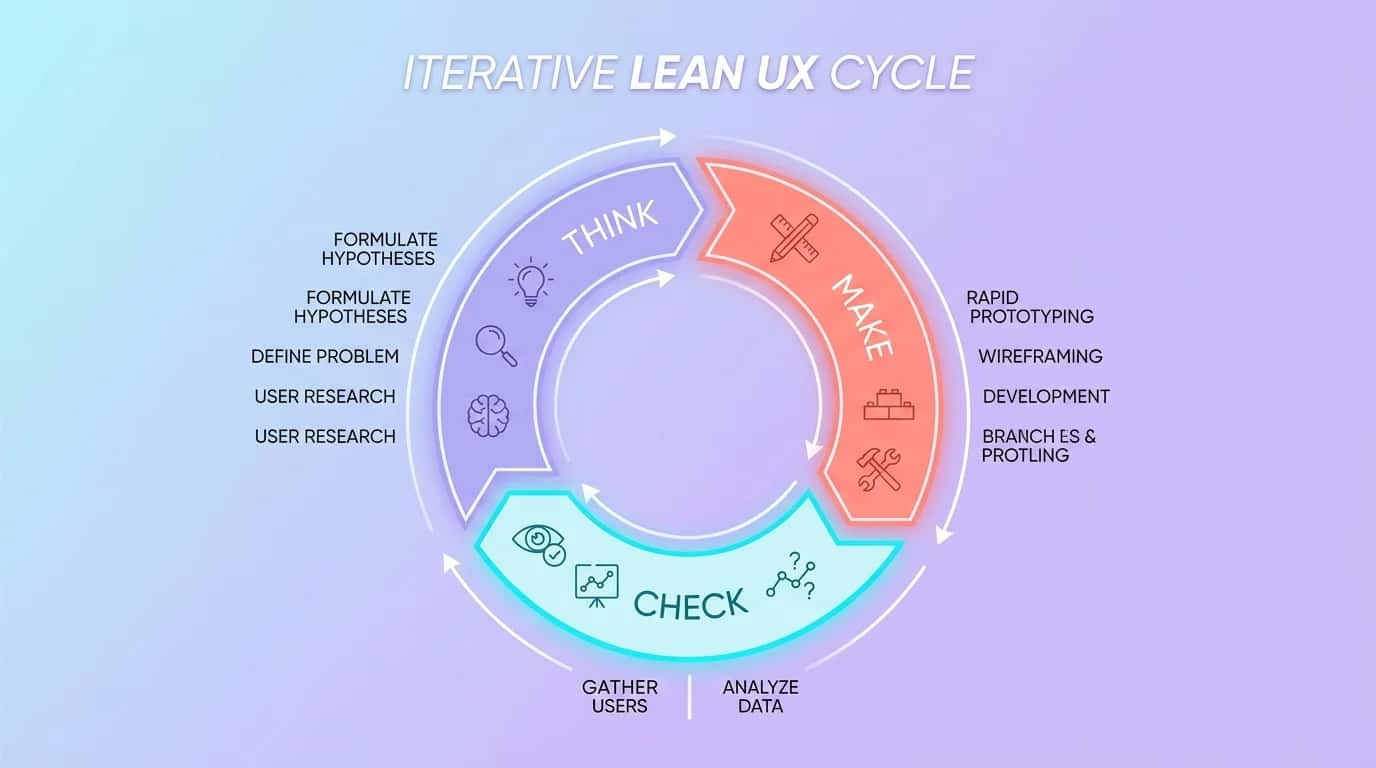
The engine of Lean UX can be summed up in three words. Think means formulating a measurable assumption. Make means building the simplest prototype capable of testing it. Check means putting that prototype in front of real users. A complete cycle takes between five and ten days.
Forget vague brainstorming. In Lean UX, every assumption follows a precise format: ‘We believe that [change X] for [user Y] will produce [outcome Z]. We will know this when [measurable metric].’ This framework forces clarity. If you cannot complete every field, the assumption is too vague to justify a prototype.
The prototype is not a pixel-perfect mock-up. It is the minimum needed to test the assumption. A paper wireframe, a clickable Figma mock-up or a disposable landing page may all be appropriate, depending on what you need to test. The rule of thumb is simple: if the prototype takes more than 48 hours, you are doing too much. Jeff Gothelf recommends aiming for a Minimum Viable Experiment, not a finished product.
Jakob Nielsen (Nielsen Norman Group, 2000) showed that five testers identify 85% of usability problems. There is no need to recruit 50 people. Five 20-minute interviews are enough to validate or disprove an assumption. What matters is observing behaviour, not asking for opinions.
Étape 1
Bring developers, designers and the product owner into the same room. Use existing evidence, including analytics, heatmaps and support feedback, to identify the most critical user problem. Write two or three assumptions in the standard format, then vote on which one to test first.
Étape 2
Each person sketches their answer in six minutes using the Design Studio exercise. Compare the proposals and converge on a single concept. Build a clickable screen in Figma or on paper, not an entire design system. The prototype must feel realistic enough to prompt an honest response from the tester.
Étape 3
Recruit five testers from your existing customer base or through a tool such as Maze. Observe without guiding them and resist the urge to explain the interface. Record every point of friction and measure completion of the target task. Save the sessions so the team can revisit key moments.
Étape 4
Does the evidence validate the assumption? Move on to developing the feature. Has it disproved it? Pivot to a new assumption without regret. That is precisely why you invested 48 hours in a prototype rather than three months in code. There is no debate based on opinion: the evidence decides.
Étape 5
Restart the cycle with the next assumption in the backlog. Every sprint refines the product and deepens your understanding of its users. After three or four complete iterations, or roughly one to two months, you have an MVP tested and validated by real users.
All three approaches share the aim of designing for users, but they differ radically in how they achieve it. A common mistake is to assume that Lean UX replaces everything else. Each method has its place, and combining them without judgement produces the worst of all three worlds.
Traditional UX design excels in highly regulated projects, such as banking and healthcare, where every decision must be documented and traceable. Design Thinking is strongest during exploration, when the point of friction itself remains unclear and the team needs empathy before acting. Lean UX takes over once the problem has been identified and potential solutions need rapid validation.
How should you choose? Ask one question: do you know which problem needs solving? If not, start with Design Thinking. If you do, but the solution remains uncertain, use Lean UX. If the solution is known and compliance is the priority, traditional UX is the right choice.
| 01Criterion | 02Traditional UX | 03Design Thinking | 04Lean UX |
|---|---|---|---|
| 01Cycle length | 4-12 weeks | 1-5 days (facilitated session) | 5-10 days |
| 02Main deliverable | Detailed specifications and UX audit | Persona and empathy map | Testable prototype and evidence |
| 03Ideal team size | One UX designer or a pair | 5-8 people (facilitated session) | 3-8 people (multidisciplinary) |
| 04Validation | Formal client review | Co-creation with stakeholders | Testing with real users |
| 05Best suited to | Regulated projects and large budgets | Exploring poorly defined problems | Rapid iteration and MVPs |
| 06Main risk | Excessive documentation and delay | Ideas without execution | Compromised quality if poorly framed |
Cycle length
Main deliverable
Ideal team size
Validation
Best suited to
Main risk
Jeff Gothelf and Josh Seiden formalised these principles in Lean UX: Designing Great Products with Agile Teams (O'Reilly, third edition, 2021). They underpin the entire method.
Developers, designers and product owners work together from day one. There is no brief thrown over the wall, and no designer working alone while development waits. This close collaboration reduces back-and-forth and speeds up decisions.
A wireframe has no intrinsic value. What matters is whether the conversion rate changed and whether the user found the form. Measuring impact replaces the production of documents, which changes the team's culture.
If 100% of your assumptions are validated, they were not ambitious enough. A useful benchmark is a validation rate of 60-70%, with the remainder generating insight. Failing quickly costs less than an unsuccessful launch after six months of development.
This principle comes directly from the Toyota Production System (TPS). Any activity that does not directly improve your understanding of the user is waste. A 45-minute status meeting is waste. So is an 80-page specification that nobody reads.
Every sprint produces knowledge. Even an unsuccessful prototype teaches you something about your users. Record those insights in a lightweight format, such as a shared Notion page rather than a 20-page report, so the next team can benefit.
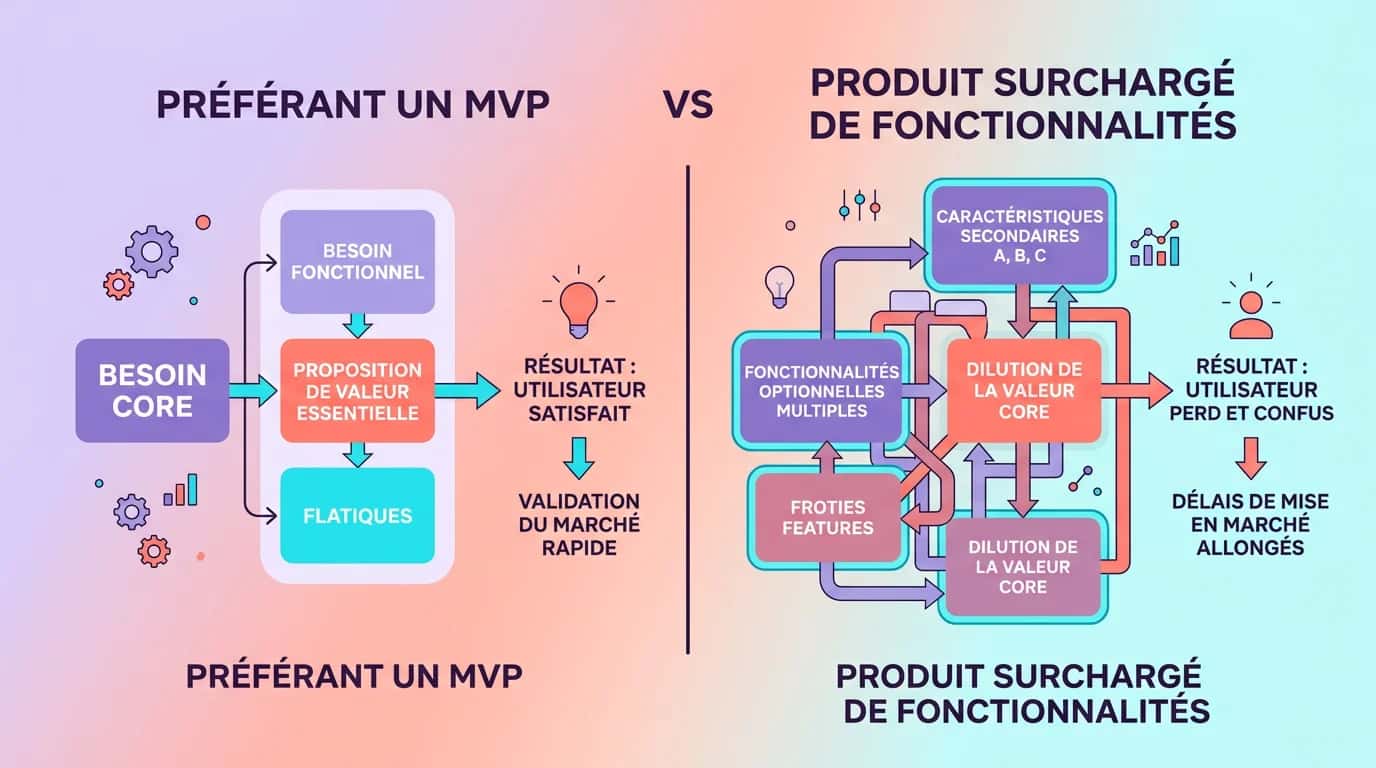
The MVP, or Minimum Viable Product, is at the operational heart of Lean UX. It is not a cut-price product. It is the smallest testable version of your idea. A one-page form can be an MVP, as can a demonstration video. Dropbox validated its concept with a simple three-minute video before writing any code, resulting in 75,000 sign-ups within 24 hours.
Why does this work for SMEs? Because budgets are limited. Investing €15,000 in a complete website before knowing whether visitors want to buy online is a risky bet. Launching a €500 landing page to measure interest is Lean UX in practice. For a practical continuation, see Website Redesign Checklist.
The MVP does have limitations. On an ecommerce website with a catalogue of 5,000 products, a paper prototype cannot test real navigation. The approach can validate a purchase journey or value proposition, but it cannot test technical performance or complex use cases at scale. Keep that in mind before prototyping everything in Figma.
Adopting Lean UX does not require you to overturn everything at once. Start with one project and one team.
First, identify a feature or page that is underperforming, perhaps through a high bounce rate, an abandoned form or a basket that does not convert. This is your testing ground. Form an assumption about the cause of the problem, not the solution.
Second, build a small team consisting of a designer, a developer and a product lead. Three people are enough. With more than eight, meetings begin to slow progress and Lean UX loses its speed advantage. To take this further, read UI Designer.
Third, reserve two hours each week for user testing. You do not need a UX lab. A 20-minute Zoom call with an existing customer can produce actionable findings. Tools such as Maze or Hotjar can show you where users get stuck without the need for a conversation.
Start your first Lean UX sprint this week: choose the page with your highest bounce rate and formulate an assumption about what is driving visitors away.
Lean UX is not universal. Detailed documentation is a legal requirement for projects subject to strong regulatory constraints, such as medical devices and banking applications governed by the CNIL. A Figma prototype cannot replace a compliance file. Traditional UX remains the right choice in these cases.
Highly hierarchical organisations pose another limitation. If every decision must pass through four levels of approval, a ten-day cycle becomes ten weeks. Lean UX requires autonomy. The team must be able to decide without waiting for an executive committee. Without that authority, the method consistently fails.
Finally, beware the ‘quick and dirty’ trap. Very short sprints without rigorous testing produce mediocre interfaces disguised by a fashionable methodology. Speed without discipline is simply organised chaos. As Josh Seiden puts it: ‘Speed without learning is just moving fast in the wrong direction.’ Test the method on a small part of your organisation before applying it to every project.
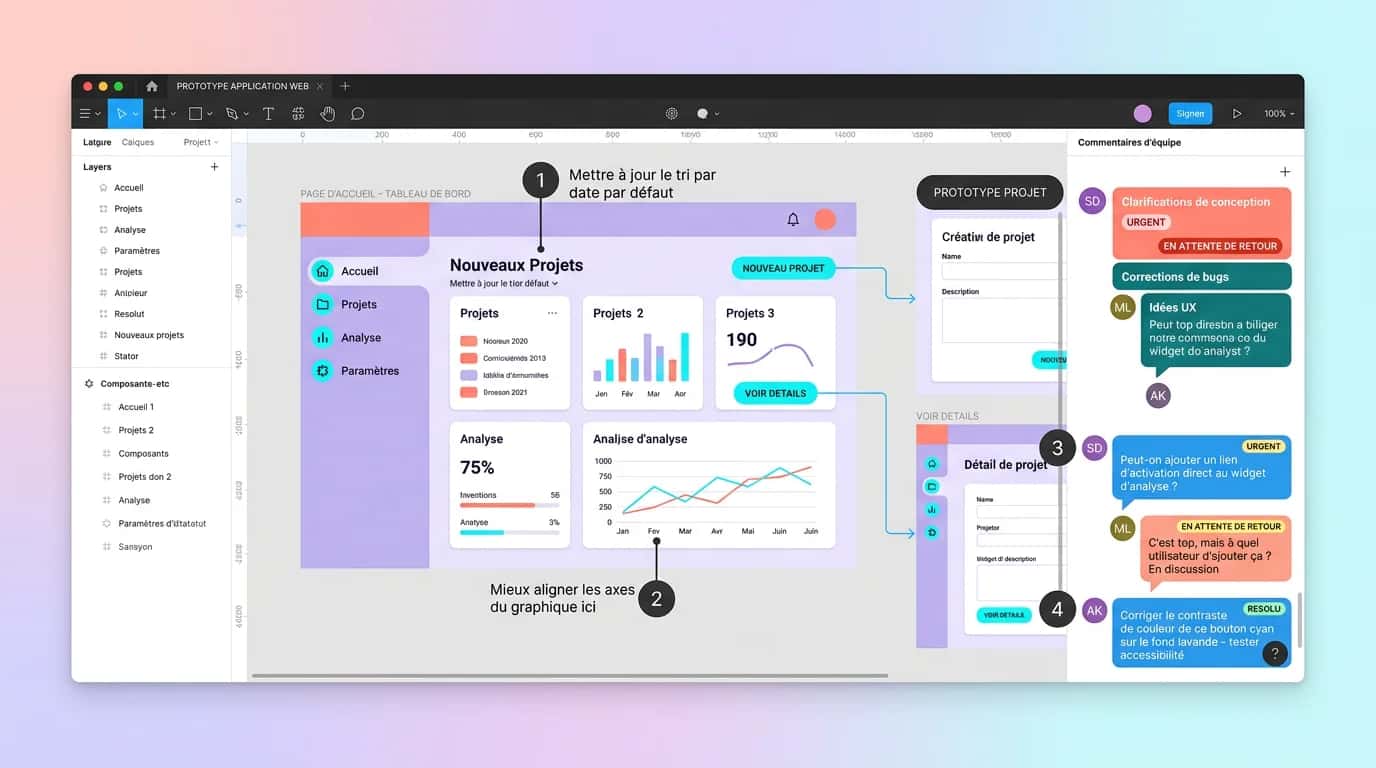
Our designers apply Lean UX principles to create interfaces that convert, without wasting your budget on features nobody needs.
Last updated: April 2026
Lean UX changes the way web projects are designed, but it does not work in isolation. It belongs within a broader set of UX capabilities that every company adapts to its own circumstances.
If you are considering a UX redesign of an existing website, Lean UX can help you prioritise high-impact changes without rebuilding everything. A user experience consultant can structure your first sprints and help your team adopt the method over a few weeks.
If you are starting from scratch, our guide to website design covers the visual and structural foundations to establish before you begin iterating. To measure how UX improvements affect conversion, see our article on improving website conversion rates for the metrics worth tracking.
Lean UX is a capability that develops sprint by sprint. Each cycle makes you faster, more precise in your assumptions and more confident in your design decisions. Our page on UX and UI explains the next step.
Keep exploring
A project in mind?
Start with a free audit grounded in your goals, website and data.
Discutons de votre projet
30 min · Google Meet
Choisissez le créneau qui vous convient dans notre calendrier. On analyse votre situation avant l’appel pour aller droit au but.
Finding available times...