

Refonte

La Refonte insights
Your choice of website redesign agency determines whether the investment delivers qualified prospects or simply drains cash. Use these objective criteria, 2026 budget benchmarks and 11 precise questions.
Refonte

SEO

IA
According to HubSpot (2025), the average conversion rate for an SME website more than four years old is 0.8%, compared with 2.4% for a site redesigned within the year. If yours is lower, here is why.
Choosing the right website redesign agency is not a minor decision: it determines whether the investment produces qualified prospects or simply drains cash.
This guide provides objective criteria, 2026 budget benchmarks and 11 precise questions that separate serious agencies from polished salespeople.
A website more than four years old loses an average 23% of its organic traffic each year without a redesign, according to Semrush analysis (2024).
Google's algorithms reward the signals captured by Core Web Vitals, while unmaintained content management systems accumulate technical debt that directly harms rankings.
A Lyon consultancy we support had a site dating from 2019. Organic traffic had fallen by 60% in three years, bounce rate exceeded 78% and its inbound lead pipeline had been empty for
18 months. The website was not broken. It had become invisible.
Lost credibility affects prospects before they read a single line. According to Baymard Institute (2024), 38% of users leave a site whose design looks dated.
For an SME, an ageing website is not an aesthetic problem. It is a sales-pipeline problem.
Google Search Console shows the warning sign: if impressions are falling and your average
Position exceeds 25 for strategic keywords, the problem is structural and cannot be solved with a visual refresh.
The return on a complete redesign depends on the sector and scope. These benchmarks come from French SMEs that redesigned their websites between 2023 and 2025:
| SME sector | Average redesign budget | Conversion rate before | Conversion rate after | Payback period |
|---|---|---|---|---|
| B2B services (consulting, legal) | €18,000–€30,000 | 0.8% | 2.6% | 8–14 months |
| Industry / manufacturing | €12,000–€20,000 | 0.5% | 1.9% | 10–18 months |
| SME ecommerce | €25,000–€60,000 | 1.1% | 3.2% | 6–12 months |
| Professional services / healthcare | €6,000–€15,000 | 1.2% | 3.8% | 4–8 months |
These figures assume a complete redesign covering information architecture, technical SEO, design and content, rather than a cosmetic lift. A 38-person transport company in Nantes invested €22,000 in a website transformation that included moving from WordPress to Webflow. Within 12 months, organic traffic rose by 145% and inbound quote requests by 67%. The investment paid for itself in 11 months. Our guide to the stages of a successful redesign explains every operational phase.
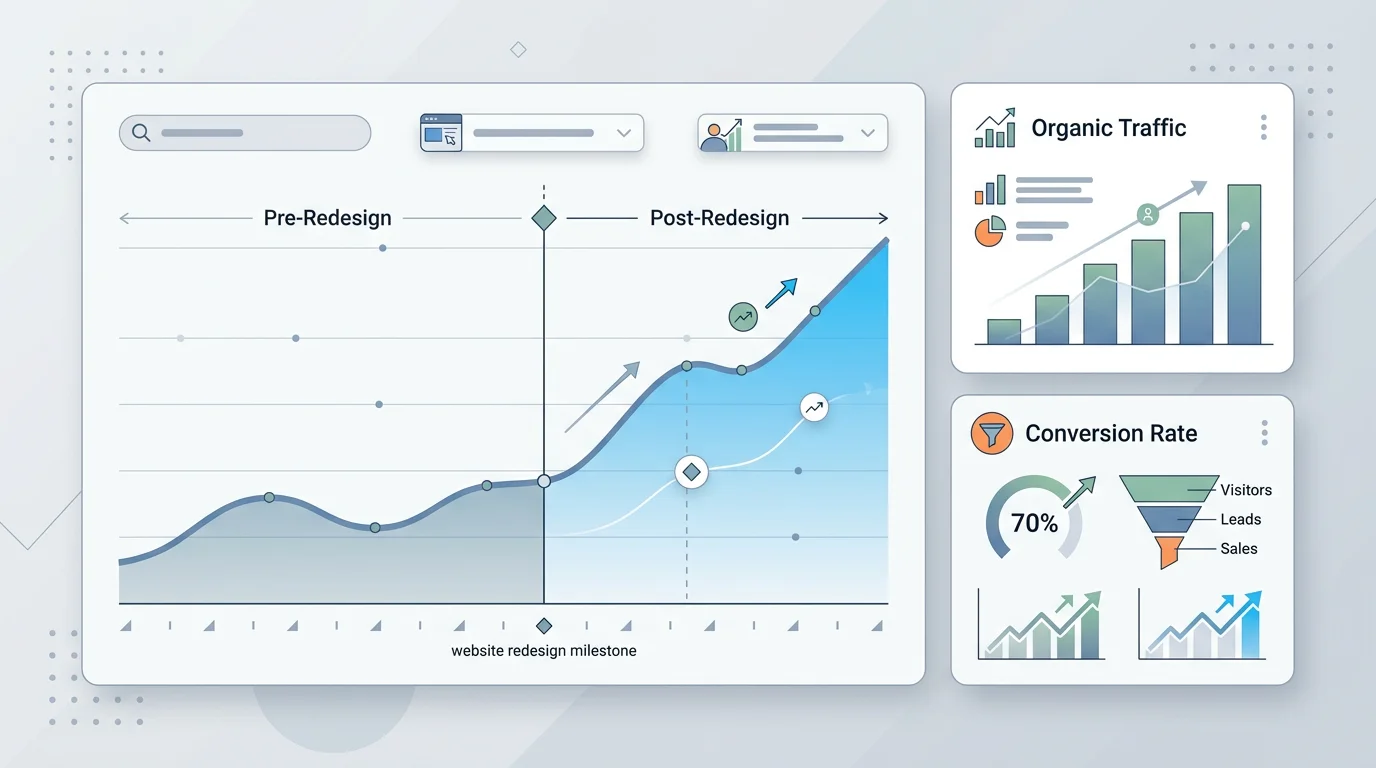
A redesign with poor technical SEO management can erase years of work within weeks.
According to Ahrefs (2024), 60% of redesigns cause traffic to fall in the first three months because of avoidable errors: poorly configured 301 redirects, missing canonical tags and incoherent heading structures.
Your agency should present a documented SEO migration protocol, including a Google Search Console audit before launch, a map of existing URLs and post-launch tracking for strategic keywords.
Without this protocol, 'SEO redesign' is merely a sales claim.
A serious agency produces a structured specification before touching the interface. It should contain an audit of the existing site, analysis of direct competitors, low-fidelity wireframes approved by you and measurable six- and 12-month KPIs. If design begins before this stage, scope creep and disappointing deliverables become much more likely. Ask to see a specification from a comparable project. Our article on the redesign specification explains exactly what it should contain and what is most often missing.
A website delivered without a maintenance agreement starts to deteriorate within six months.
WordPress security updates, plugin fixes and minor content changes all require a responsive contact after launch.
Insist on a clear support agreement stating the guaranteed response time, no more than 48 working hours, the work included each month and the terms for exceeding it.
Agencies offering no post-launch maintenance statistically create more dissatisfied clients, because real life starts after launch.
WordPress remains the most common option, but it is not always the best one.
Webflow provides stronger Core Web Vitals performance for SME brochure sites and reduces long-term technical debt.
The agency should justify its technology according to your actual constraints: editorial autonomy, page volumes and CRM or ERP integrations.
If it recommends the same stack every time without considering your needs, the advice reflects its comfort zone rather than your interests.
Portfolio screenshots are not enough. Ask for live URLs, contact details for a client reference and measurable results covering traffic, leads and conversions.
An agency that has redesigned websites in your sector already understands the target users' expectations and the benchmarks that matter.
Sector specialisation shortens discovery by 30–40%. Without verifiable references, a portfolio is only a shop window.
Generalist agencies often charge 30–40% less than specialists.
In return, they juggle ecommerce, mobile apps, advertising and website redesigns without deep expertise in any one area.
The main risk is a rushed SEO migration. A 24-person medical distributor in Bordeaux paid a generalist agency €11,000 for a redesign.
Six months later, organic traffic had fallen by 54%, with 2,400 missing redirects and no canonical tags. A specialist agency charged another €8,000 to put it right.
A specialist redesign agency charges more because it delivers measurable results that generalists do not achieve.
It understands SEO migration pitfalls, UX testing and tools such as Google Analytics 4 and Microsoft Clarity.
According to WordStream (2024), SMEs choosing a specialist provider achieve 2.3 times the return after 18 months compared with SMEs choosing a cheaper generalist agency.
The difference lies in technical execution, not graphic creativity.
Two HR-sector SMEs redesigned their websites in 2024. The first chose a generalist agency for €9,500. Delivery took ten weeks, but there was no redirect strategy or Core Web Vitals monitoring.
After six months, organic traffic was down 31%.
The second chose a specialist for €21,000. Over 16 weeks, it received a complete SEO audit, documented migration and testing with three personas. The result was 78% more organic traffic and 112% more contact enquiries.
The €11,500 budget difference was repaid within four months.
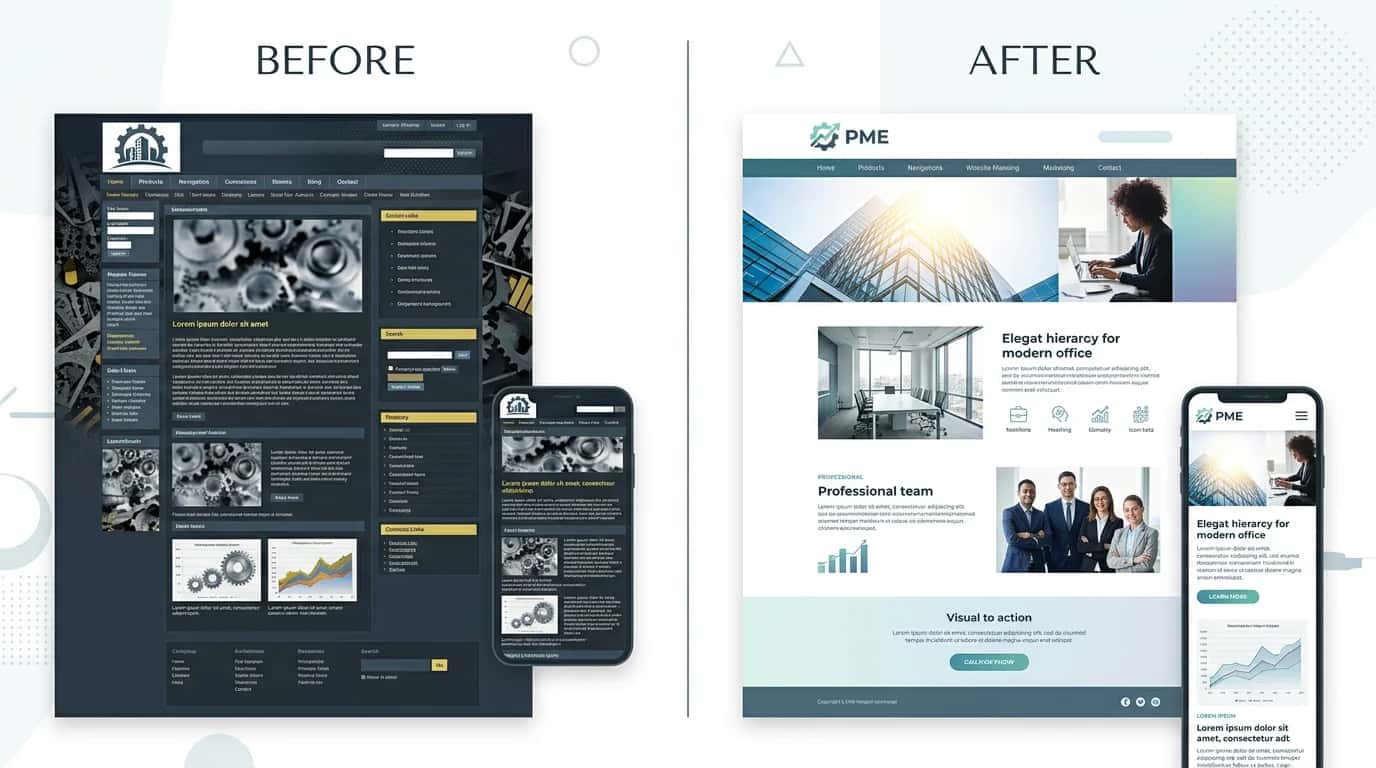
Complete redesign prices vary with website size, technology and scope. Our guide to the cost of a website redesign provides a detailed breakdown by project and provider type.
These are the ranges observed in the French market in 2026:
| Business profile | Volume / complexity | Redesign budget | Typically included |
|---|---|---|---|
| Microbusiness / freelancer | 5–15-page brochure site | €5,000–€15,000 | Design, CMS implementation, basic on-page SEO |
| SME (10–50 people) | 20–80 pages, blog, forms | €15,000–€50,000 | Audit, UX, technical SEO, 12-month maintenance |
| Ecommerce SME | Product catalogue, checkout journey | €25,000–€60,000 | Data migration, ERP/CRM integration, checkout tests |
| Mid-sized company (50–500 people) | 100+ pages, multilingual, bespoke | €50,000 and above | Content governance, RGAA accessibility, business-system integrations |
Four variables push redesign budgets beyond initial estimates.
An ecommerce migration, such as WooCommerce to Shopify or PrestaShop, accounts for 20–35% of the total cost because product, order and customer data must move.
Bespoke integrations with Sage ERP, Salesforce CRM or HubSpot add €4,000–€15,000 on average depending on the API.
The real page count, underestimated by 40% in briefs, and content writing are the other two areas to define before signing.
The most common trap is a quote 'excluding content': the agency delivers the technical structure, but writing, photography and translation are not included. These items account for an average 25–40% of a complete website redesign budget. Check every line: first-year hosting and domain, CMS handover, third-party licences for premium themes or paid plugins, and stock-image credits. An unusually low quote almost always hides omissions. The ultimate redesign checklist helps you audit every quote before committing.
An internal team can manage a redesign if it includes an experienced front-end developer, a hands-on SEO lead and a part-time dedicated project manager.
This works for websites below 30 pages using technology the team understands well.
The reality, according to Statista (2024), is that fewer than 15% of French SMEs have all three profiles. Underestimating the skills required is the leading cause of failed in-house redesigns.
An external provider brings two benefits an internal team cannot replicate: specialisation and no fixed employment cost.
A specialist agency knows the pitfalls, proven shortcuts and measurement tools suited to your sector.
It brings together three to five complementary specialists for the project's duration, with no recruitment on your side.
According to HubSpot (2025), SMEs that outsource launch 40% sooner than those managing the work internally.

Before contacting an agency, spend two hours in Google Search Console and Google Analytics 4 documenting
The website's real position: 12 months of organic traffic, the strongest pages, conversion rates and Core Web Vitals scores.
Do the same for three competitor sites you admire. Use Wappalyzer to identify their technology, then study navigation and loading speed.
This diagnosis lets you brief agencies with concrete data.
Use this article's criteria as the initial filter. Look for specialists using searches such as 'website redesign agency [your sector]' or 'SME website redesign provider France'.
Always verify the founding date, at least three years ago; team size on LinkedIn; a portfolio with testable URLs; and Google reviews above 4.2 with responses.
Stop at five agencies. Any more makes comparison counterproductive.
Arrange a 45-minute call with every shortlisted agency. Send a one-page brief in advance covering objectives, context, approximate budget and desired timing, together with read-only Google Analytics 4 and Search Console access. Ask the 11 questions above and score the answers. Observe the structure, too: a serious agency spends 60% of the call asking questions, not selling itself. If you need a redesign focused on organic performance, our SEO redesign service measures impact from the first month after launch.
Compare quotes using one grid: included scope, proposed technology, design iterations, contractual deadline, post-launch maintenance and measurable KPIs.
Do not negotiate on price alone; negotiate the scope.
An additional six months of maintenance protects your investment better than a 10% discount.
If two agencies are close in quality, the contact's responsiveness and clarity when answering the 11 questions often predict the working relationship over a four- to six-month project.
A hybrid model works well when you have an in-house writer or marketing project manager but lack technical and SEO expertise. The agency leads architecture, development and organic search, while your team produces content and co-ordinates subject matter. This reduces the agency bill by 20–30% and strengthens internal ownership. The real difficulty is the boundary of responsibility. Without a clear contract stating who approves what and when, hybrid projects always slip. Our website redesign service includes a free initial scoping session to define these responsibilities.
Choosing a website redesign agency means choosing a partner for one of your SME's most important investments.
Technical criteria such as SEO migration, Core Web Vitals and a documented method matter as much as the price. Read our complete website redesign guide to understand every stage.
A quote that is 30% cheaper but causes traffic to collapse costs far more than it saves.
Two variables determine success: the quality of the chosen agency and the precision of your initial brief.
La Refonte supports French SMEs throughout the redesign cycle, from initial audit to 12-month performance monitoring. If you want an honest assessment of your project, including a realistic budget, timetable and identified risks, our team offers a no-obligation first conversation. Explore our redesign approach and see whether it fits your circumstances.
Complete redesign, migration and a new visual direction: we turn your site into a conversion engine.
Keep exploring
A project in mind?
Start with a free audit grounded in your goals, website and data.
Discutons de votre projet
30 min · Google Meet
Choisissez le créneau qui vous convient dans notre calendrier. On analyse votre situation avant l’appel pour aller droit au but.
Finding available times...


How to assess an agency: 11 questions that reveal everything
11 questions for the first decision-making call
These questions distinguish structured agencies from salespeople who disguise a lack of expertise. Ask them in this order during the first discovery call and score each answer from one to five:
Red flags: agencies that cost more in the long run
Avoid any agency promising a complete SME redesign in under eight weeks. That timetable physically excludes a serious audit, approved wireframes and user testing.
Beware of agencies that ask no questions about your sector on the first call: they are selling a product, not solving a problem.
A portfolio with no verifiable URLs, or a team of fewer than three handling €40,000 projects, are clear risk indicators.
Green flags: the characteristics of a serious agency
Good agencies ask more questions than they answer during the first conversation.
Before pricing, they request read-only access to Google Analytics 4 and Search Console because they need real data to assess migration complexity.
They present a structured contract with milestones, detailed deliverables and a delay penalty.
They can also say 'no' when a project falls outside their expertise, a sign of honesty rather than weakness.